
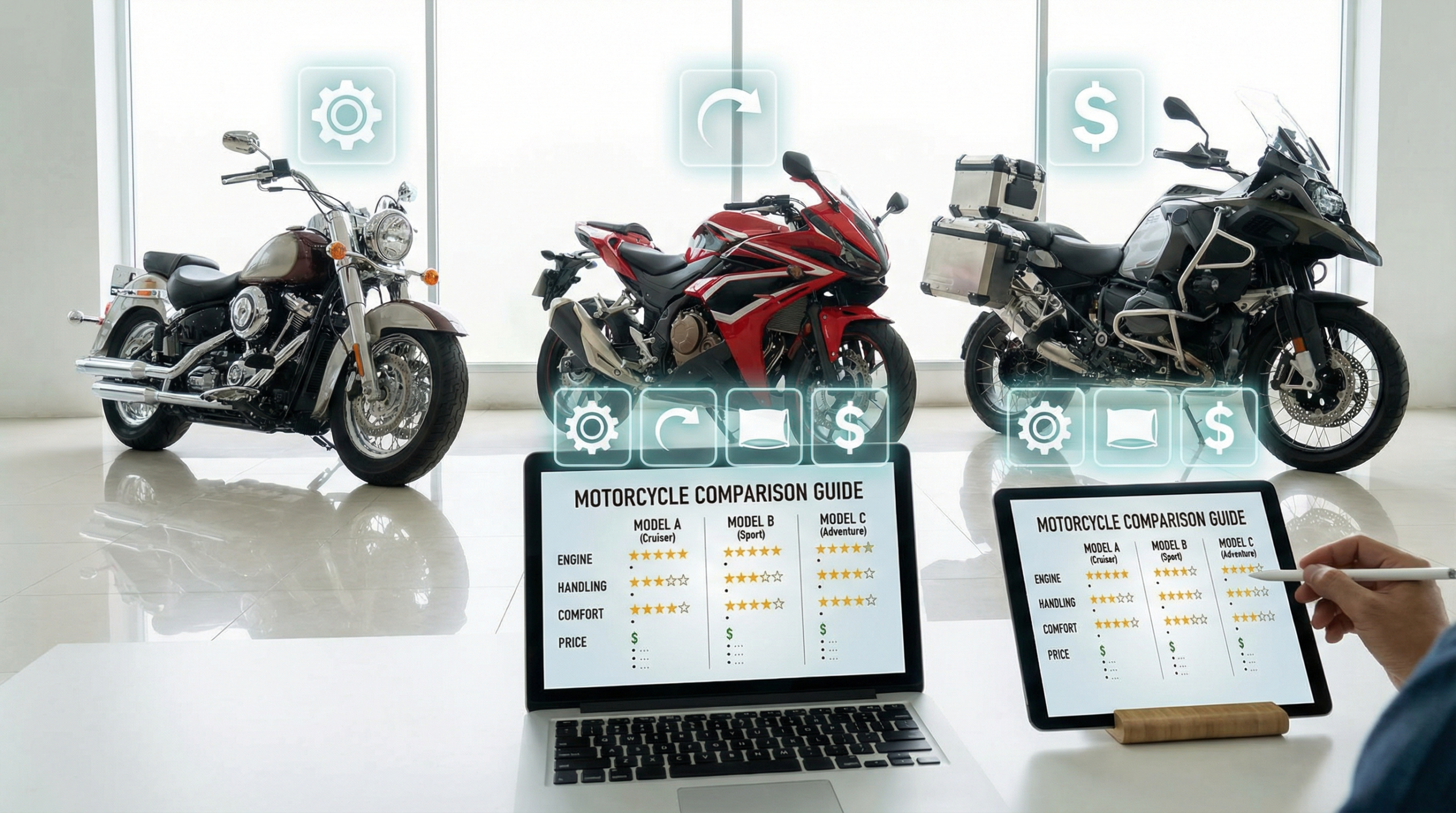
Choosing a Motorcycle That Fits You
Buying a motorcycle is about more than choosing an engine size, brand, or style that looks good. The right motorcycle should fit your riding style.
A motorcycle that works well for commuting may not be ideal for long-distance touring. Likewise, a bike that feels exciting on winding roads may not provide the comfort, storage, or range you want for extended trips.
That’s why motorcycle comparison should start with your needs, not a list of specifications.
Ask yourself where you will ride, how far you might travel, how much experience you have, and what matters most to you—comfort, performance, handling, fuel range, passenger capacity, or available technology.
This guide walks through the most important factors to consider when comparing motorcycles so you can narrow your choices and make a more informed buying decision.
Start With How You Plan to Ride
Before comparing specific motorcycles, think about how you expect to use the bike. Your riding environment and typical trips can have a bigger impact on the right choice than horsepower or styling alone.
Commuting and Everyday Riding
If the motorcycle will be used primarily for commuting or short trips, consider factors such as manageable weight, comfortable ergonomics, fuel economy, easy maneuverability, and practical storage.
A motorcycle that is easy to handle in traffic and simple to live with every day can be more useful than one designed primarily for high performance.
Weekend and Back-Road Riding
For riders who spend their weekends exploring winding roads and scenic routes, handling, braking, rider position, and engine response may deserve more attention.
The goal isn’t necessarily the most powerful motorcycle. It’s finding a bike that feels predictable, comfortable, and enjoyable on the roads you ride most often.
Long-Distance Touring
Long-distance riding introduces a different set of priorities. Seat comfort, wind protection, riding position, luggage capacity, fuel range, and passenger comfort can become more important when you spend several hours in the saddle.
A motorcycle that feels great for a one-hour ride may not be nearly as comfortable after a full day on the road.
Before you go, read How to Plan Your First Multi-Day Motorcycle Tour.
Mixed or Multi-Purpose Riding
Some riders need a motorcycle that can handle several types of riding. You might commute during the week, take weekend rides, and occasionally head out on a multi-day trip.
In that situation, look for a balance between comfort, handling, performance, range, and practicality rather than optimizing for just one category.
The key is to identify your most common riding type. Once you know what you actually need the motorcycle to do, comparing specifications and features becomes much easier.
Engine Size and Performance
Engine size is one of the first specifications many riders look at when comparing motorcycles, but bigger isn’t automatically better. The right amount of power depends on how you ride, where you ride, and what you expect from the motorcycle.
Engine Size
Motorcycle engines range from small-displacement singles and twins to large multi-cylinder engines. Smaller engines can be lighter, easier to manage, and more economical, while larger engines generally provide more power and torque.
Instead of choosing a motorcycle based solely on engine displacement, consider whether its performance matches your intended use.
For example, a motorcycle used primarily for city riding may not need the same level of power as one regularly used for highway travel, carrying luggage, or riding with a passenger.
Power and Torque
Horsepower gets plenty of attention, but torque is also important. Torque affects how strongly the motorcycle accelerates, particularly at lower and mid-range engine speeds.
When comparing motorcycles, look at overall power delivery rather than focusing on a single number. A motorcycle with smooth, predictable power can be easier and more enjoyable to ride than one with significantly more performance than you actually need.
Weight and Power
Engine performance should also be considered, alongside the motorcycle’s weight.
A powerful engine in a heavier motorcycle can produce a very different riding experience from a smaller engine in a lightweight motorcycle. Weight affects acceleration, braking, maneuverability, and how the bike feels at low speeds.
This is especially important for newer riders and anyone who frequently rides in traffic, parking lots, or other situations where slow-speed control matters.
Match Performance to Your Riding
When comparing motorcycles, ask yourself:
- How much highway riding will I do?
- Will I regularly carry a passenger or luggage?
- Do I prefer relaxed cruising or quicker acceleration?
- How important are fuel economy and operating costs?
- Am I comfortable managing the motorcycle’s weight and power?
The goal isn’t to find the motorcycle with the biggest engine or the highest horsepower figure. It’s to find a motorcycle whose performance fits your experience, riding environment, and intended use.
Comfort and Ergonomics
A motorcycle can have excellent performance and plenty of features, but if it doesn’t fit you properly, riding it may become uncomfortable quickly. Ergonomics—the way the motorcycle fits your body and riding position—should be an important part of any comparison.
Seat Height
Seat height affects how easily you can reach the ground when stopped. A lower seat may provide more confidence for some riders, while a taller motorcycle can offer advantages such as increased ground clearance or a different riding position.
Don’t rely on the published seat height alone. Seat width, suspension sag, and your inseam can all affect how the motorcycle feels when you’re sitting on it.
Riding Position
Consider the position of the handlebars, seat, and foot controls.
A more upright position may work well for commuting and long-distance riding, while a more aggressive position may appeal to riders who prioritize handling and performance.
Pay attention to where your hands, wrists, knees, hips, and back are positioned. A riding position that feels comfortable during a short test ride may feel very different after several hours.
Seat Comfort
The seat plays a very important role if you plan to ride for extended periods.
Consider its width, padding, shape, and how well it supports your body. Also, think about seating position and whether it allows you to move around during a long ride.
For touring riders, passenger seating should be considered as well.
Wind Protection
Wind protection can largely affect comfort at highway speeds. Fairings, windscreens, and the overall design of the motorcycle can influence how much wind reaches your helmet and upper body.
More wind protection isn’t necessarily better for every rider, but it’s worth considering if you regularly spend time on the highway or take long-distance trips.
Weight and Low-Speed Handling
A motorcycle’s weight matters most when you’re maneuvering at low speeds, moving it around a parking area, backing it into a space, or bringing it to a stop.
When comparing motorcycles, consider both the published weight and how that weight feels when you’re actually handling the bike.
Try Before You Buy
Whenever possible, sit on the motorcycle and take a test ride before making a purchase decision.
Pay attention to how naturally you can reach the controls, whether you feel balanced at stops, how the handlebars feel, and whether the riding position remains comfortable as the ride continues.
A motorcycle that fits you well can make a significant difference in how enjoyable and practical it is to own.
Braking, Tires, and Safety Features
Performance isn’t just about acceleration. A motorcycle’s ability to slow, stop, and maintain control is just as important when you’re comparing models.
Braking components, tires, suspension, and electronic rider aids all contribute to how a motorcycle behaves in everyday riding conditions.
Braking Systems
Look at the motorcycle’s front and rear braking systems and consider whether features such as anti-lock braking systems (ABS) are available.
ABS can help prevent wheel lock during hard braking when available and functioning properly. It doesn’t eliminate the need for proper braking technique, but it can be an important safety feature to consider when comparing motorcycles.
Tires
Tires are one of the motorcycle’s most important points of contact with the road.
Consider the motorcycle’s standard tire sizes and the types of tires it is designed to use. Think about the riding you expect to do as well. A motorcycle primarily used for highway touring may have different tire requirements from one intended for aggressive cornering or mixed-surface riding.
Also consider tire replacement costs and availability as part of long-term ownership.
Suspension and Handling
Suspension affects comfort, stability, and how the motorcycle responds to changes in the road surface.
When comparing motorcycles, consider suspension travel, adjustability, and the type of riding the motorcycle was designed to handle. A suspension setup that works well for smooth pavement may not provide the same experience on rough or uneven roads.
Electronic Rider Aids
Modern motorcycles may offer features such as:
- ABS
- Traction control
- Ride modes
- Cornering-sensitive electronics
- Electronic suspension
- Tire-pressure monitoring
The availability of these features varies considerably between motorcycles and trim levels.
Rather than choosing a motorcycle because it has the longest feature list, consider which systems provide useful benefits for the type of riding you actually do.
Look at the Whole Package
Brakes, tires, suspension, and electronic systems work together. When comparing motorcycles, don’t evaluate any one feature in isolation.
Consider how the motorcycle’s overall braking and handling characteristics fit your experience level, riding environment, and intended use.
The goal is not simply to find the motorcycle with the most technology. It’s to understand which safety and control features are available and determine which ones matter most for the way you ride.
To discover some good riding skills, see Motorcycle Riding Safety Fundamentals.
Fuel Economy and Range
Fuel economy is worth considering when comparing motorcycles, but the number published by a manufacturer is only part of the picture. Your actual fuel consumption can vary depending on riding style, speed, traffic, terrain, weather, passenger weight, and luggage.
For many riders, fuel range can be just as important as fuel economy.
Fuel Economy
A motorcycle with good fuel economy can help reduce the ongoing cost of riding, particularly if you use it regularly for commuting or longer trips.
When comparing models, look at the manufacturer’s estimated fuel economy, but treat it as a reference point rather than a guarantee of what you will achieve.
Real-world fuel consumption can differ considerably from published estimates.
Fuel Tank Capacity
Tank size helps determine how far you can travel between fuel stops.
A motorcycle with excellent fuel economy but a small fuel tank may have a similar practical range to a motorcycle with lower fuel economy and a larger tank.
This is why fuel economy and tank capacity should be considered together.
Highway and Touring Range
Range becomes particularly important on longer motorcycle trips.
If you regularly ride through rural areas, mountain roads, or other locations where fuel stations may be less frequent, having enough range between stops can make trip planning easier.
For touring motorcycles, consider whether the expected range fits comfortably with the routes you plan to ride.
Don’t Chase Range Alone
A longer range isn’t automatically better for every rider.
If most of your riding takes place around town, you may rarely need the additional range provided by a larger fuel tank. A smaller, lighter motorcycle may make more sense for your everyday needs.
On the other hand, riders who frequently travel long distances may place greater value on fewer fuel stops and longer stretches between stations.
Consider Your Real-World Use
When comparing motorcycles, ask:
- How many miles do I typically ride in a day?
- How much of my riding is highway travel?
- How often will I ride in remote areas?
- How important are fuel costs to my budget?
- Will luggage or a passenger affect my typical fuel consumption?
The best fuel economy and range combination is the one that fits your riding habits. Consider both the numbers and how they translate to the roads and distances you actually ride.
Technology and Rider Aids
Motorcycle technology has expanded significantly, but more technology doesn’t necessarily mean a better motorcycle for every rider. When comparing models, consider how each feature can improve your particular riding experience.
Rider Information
Depending on the motorcycle, available information may include:
- Digital or TFT displays
- Gear position
- Fuel consumption
- Riding modes
- Tire-pressure information
- Navigation
- Maintenance reminders
A clear, easy-to-read display can be particularly useful during everyday riding and long-distance travel.
Ride Modes and Traction Control
Some motorcycles offer multiple ride modes that change throttle response or other characteristics of the motorcycle.
Traction control can also help manage rear-wheel slip under certain conditions.
These systems vary considerably between manufacturers and models, so it’s worth understanding exactly what a particular system does rather than assuming that two motorcycles with the same feature name operate identically.
Connectivity
Bluetooth connectivity, smartphone integration, and navigation features can make certain motorcycles more convenient for riders who spend significant time on the road.
However, consider whether you’ll actually use these features. If you prefer a simple riding experience, a motorcycle with fewer electronic features may be perfectly suitable.
Electronic Suspension and Other Advanced Features
Higher-end motorcycles may offer features such as electronically adjustable suspension, adaptive lighting, keyless ignition, or additional electronic rider aids.
These features can add convenience and capability, but they can also increase the complexity of the motorcycle.
When comparing models, consider both the benefit of the feature and whether it justifies the additional cost and complexity for your type of riding.
Technology Should Support the Ride
It’s easy to get caught up in a motorcycle’s technology list. Instead, focus on how those features affect your experience.
Ask yourself:
- Will this feature make riding easier or safer?
- Will I use it regularly?
- Does it solve a problem I actually have?
- Is it included on the model or trim level I’m considering?
- Does the added technology affect the purchase price or long-term ownership?
The most useful technology is technology that supports the way you ride. A motorcycle doesn’t need the longest feature list to be the right motorcycle for you.
Maintenance and Ownership Considerations
Buying a motorcycle is only the beginning of the ownership experience. Maintenance, operating costs, insurance, and parts availability can all affect how practical a motorcycle is over time.
Two motorcycles with similar purchase prices can have very different ownership costs, so it’s worth looking beyond the initial price tag.
Routine Maintenance
Every motorcycle requires regular maintenance, but service requirements can vary between models.
Before buying, review the manufacturer’s recommended maintenance schedule and consider the cost of routine services such as:
- Oil and filter changes
- Brake inspections
- Tire replacement
- Chain or belt maintenance
- Air-filter replacement
- Valve inspections
- Battery replacement
If you plan to perform some maintenance yourself, also consider how accessible the motorcycle’s service points are and whether you have the tools and experience required.
Parts and Service Availability
Consider how easy it will be to obtain replacement parts and find qualified service.
A motorcycle that is supported by a strong dealer network or has readily available parts may be easier to maintain than one with limited support in your area.
This can be particularly important if you plan to keep the motorcycle for many years or travel long distances on it.
Insurance and Operating Costs
The purchase price doesn’t tell you the full cost of ownership.
Insurance premiums can vary based on factors such as the motorcycle, rider, location, coverage, and riding history. Fuel, tires, maintenance, registration, and other operating expenses should also be considered.
Getting an insurance quote before purchasing can give you a more realistic idea of the motorcycle’s ongoing cost.
Reliability and Ownership Reputation
Research how owners describe their long-term experiences with the motorcycles you’re considering.
Look for recurring reports about maintenance requirements, common problems, durability, and dealer support. Individual owner experiences can vary, so look for consistent patterns rather than relying on a single review.
Resale Value
If you expect to sell or trade the motorcycle later, resale value may also matter.
Research used prices for the models you’re considering and look at how quickly comparable motorcycles tend to sell. Factors such as condition, mileage, maintenance history, equipment, and market demand can all influence resale value.
The right motorcycle isn’t simply the one you can afford to purchase. It’s one whose ongoing costs and maintenance requirements fit your budget and ownership expectations.
Compare Motorcycle Types
Before comparing individual motorcycles, it helps to understand the differences between the major motorcycle types. Each category is generally designed around a different combination of riding position, performance, comfort, and intended use.
Cruisers
Cruisers typically emphasize relaxed ergonomics, low-speed comfort, and a laid-back riding experience.
They can be a good fit for riders who enjoy relaxed highway cruising, scenic rides, and a more traditional motorcycle style.
When comparing cruisers, pay attention to seat height, weight, riding position, engine characteristics, and available wind protection.
Touring Motorcycles
Touring motorcycles are designed with longer rides in mind. They commonly emphasize rider and passenger comfort, wind protection, luggage capacity, fuel range, and highway stability.
If long-distance travel is a major part of your riding, compare the seating position, storage capacity, range, and overall weight rather than focusing only on engine performance.
Discover some great long ride routes, see Best Motorcycle Roads for Beginner Touring.
Sport Motorcycles
Sport motorcycles generally prioritize handling, acceleration, braking, and responsive performance.
Their riding positions can be more aggressive, which may be less comfortable for riders who spend long periods on the highway.
Consider whether the motorcycle’s performance-oriented design matches the type of riding you actually plan to do.
Adventure and Dual-Sport Motorcycles
Adventure and dual-sport motorcycles are built with versatility in mind. Depending on the model, they may be suitable for pavement, gravel roads, or more challenging off-road terrain.
When comparing them, consider suspension travel, ground clearance, weight, seat height, tire selection, luggage options, and the percentage of your riding that will actually take place away from pavement.
Standard and Naked Motorcycles
Standard and naked motorcycles often offer a relatively upright riding position and a balance of performance, comfort, and everyday practicality.
They can be versatile choices for commuting, weekend rides, and general-purpose riding.
Don’t Choose by Category Alone
Motorcycle categories are useful starting points, but there can be considerable overlap between models.
A sport-touring motorcycle, for example, may combine performance characteristics with features designed for longer rides. Likewise, some cruisers can be equipped for touring, while some adventure motorcycles spend most of their lives on pavement.
Use motorcycle categories to narrow your choices, then compare individual models based on how you actually plan to ride.
How to Compare Two Specific Motorcycles
Once you’ve narrowed your choices to a few motorcycles, a side-by-side comparison can make the decision much easier. Instead of trying to remember every specification, focus on the factors that matter most to you.
Start With the Basics
Create a simple comparison of the specifications that are most relevant to your riding:
| Factor | Motorcycle A | Motorcycle B |
|---|---|---|
| Engine size | ||
| Horsepower | ||
| Torque | ||
| Wet weight | ||
| Seat height | ||
| Fuel capacity | ||
| Estimated fuel economy | ||
| Braking system | ||
| ABS | ||
| Suspension | ||
| Luggage capacity | ||
| Passenger accommodations |
You don’t need to compare every specification. Focus on information that could affect how you will actually use the motorcycle.
Compare the Riding Experience
Specifications don’t tell the whole story.
If possible, sit on both motorcycles and take each one for a test ride. Pay attention to:
- How easily you can reach the controls
- Your riding position
- Low-speed balance and maneuverability
- Throttle response
- Braking feel
- Suspension response
- Wind protection
- Seat comfort
- Overall confidence and control
A motorcycle that looks better on paper may not be the one that feels better suited to you.
Compare the Costs
Look beyond the purchase price.
Consider insurance, fuel, routine maintenance, tires, accessories, registration, and any equipment you’ll need to add. If you’re financing the motorcycle, include the total financing cost in your comparison as well.
Compare What You Actually Need
Finally, identify the areas where each motorcycle has an advantage for your particular use.
For example, one motorcycle may offer more power while another provides better wind protection and luggage capacity. Neither characteristic is automatically more important—the answer depends on what you plan to do with the motorcycle.
A simple comparison table can help you see those differences clearly and prevent one impressive specification from overshadowing everything else.
The goal of a motorcycle comparison isn’t to find a universal winner. It’s to determine which motorcycle best matches your riding needs, preferences, and budget.
A Simple Motorcycle Comparison Checklist
Once you’ve narrowed your choices, use this checklist to make sure you’re comparing the motorcycles on the factors that actually matter to you.
Riding Needs
- ☐ What type of riding will I do most often?
- ☐ Will I primarily ride around town, on highways, or on longer trips?
- ☐ Will I regularly carry a passenger or luggage?
- ☐ Does the motorcycle fit my typical riding environment?
Fit and Comfort
- ☐ Is the seat height manageable for me?
- ☐ Does the riding position feel natural?
- ☐ Can I comfortably reach the handlebars and controls?
- ☐ Does the seat provide enough support?
- ☐ Is the wind protection appropriate for my riding?
Performance and Handling
- ☐ Is the engine performance appropriate for my experience and needs?
- ☐ Does the motorcycle feel manageable at low speeds?
- ☐ Are the brakes and tires appropriate for the type of riding I do?
- ☐ Does the suspension provide the balance of comfort and handling I want?
Safety and Technology
- ☐ Does it have ABS?
- ☐ Does it offer traction control or selectable ride modes?
- ☐ Are the available electronic features useful to me?
- ☐ Can I easily read and operate the motorcycle’s controls and display?
Practicality
- ☐ Is the fuel range sufficient for my typical rides?
- ☐ Does it have enough storage or luggage capacity?
- ☐ Is passenger accommodation adequate if needed?
- ☐ Are parts and service readily available?
Ownership Costs
- ☐ Can I comfortably afford the purchase price?
- ☐ Have I checked insurance costs?
- ☐ What are the expected maintenance costs?
- ☐ How much do replacement tires and other wear items cost?
- ☐ Does the motorcycle fit my long-term budget?
Final Comparison
After going through the checklist, identify the three to five factors that matter most to you.
Those priorities should carry more weight in your decision than minor differences in specifications.
A good motorcycle comparison isn’t about checking every box. It’s about understanding the differences and deciding which ones matter most for the way you ride.
Final Thoughts
Comparing motorcycles is about more than looking at engine size, horsepower, or the number of features a motorcycle offers. The most important question is whether the motorcycle fits the way you actually ride.
Consider your riding environment, experience level, comfort, performance needs, safety features, fuel range, maintenance requirements, and overall ownership costs. Then compare the motorcycles that fit those needs rather than trying to find the motorcycle with the most impressive specifications.
Whenever possible, sit on the motorcycles you’re considering and take them for a test ride. Pay attention to how they feel at low speeds, how naturally you can reach the controls, and whether the riding position remains comfortable as the ride continues.
Take your time, compare the details that matter to you, and look beyond the initial purchase price.
The right motorcycle is ultimately the one that fits your riding needs, your preferences, and your budget.
If you’re ready to explore more motorcycle content, visit the Motorcycle Hub for riding guides, gear information, reviews, travel resources, and practical information for riders.
Do you have a favorite ride or gear recommendation? Let us know.