

Motorcycle accessories can make a noticeable difference in how comfortable, convenient, and enjoyable your rides become. Whether you’re commuting to work, exploring winding back roads, or planning a long-distance motorcycle trip, the right upgrades can help you get more out of your time on the road.
But with so many products available, choosing which accessories are actually worth buying isn’t always easy.
Some accessories solve everyday problems, such as keeping your phone secure or providing a convenient way to charge other devices. Others improve wind protection, increase storage capacity, or make longer rides more comfortable.
The key is choosing accessories that match your motorcycle, riding style, and practical needs, not adding equipment just because it’s popular.
In this guide, we’ll explore some of the best motorcycle accessories worth considering in 2026, including:
- Phone mounts: Convenient access while keeping your device securely mounted.
- USB chargers: Practical charging solutions for phones and other electronics.
- Bluetooth communication systems: Hands-free communication and audio features for compatible helmets.
- Motorcycle luggage: Storage options for commuting, day trips, and longer journeys.
- Windshields and wind protection: Accessories that can help reduce wind fatigue.
- Comfort upgrades: Practical improvements for longer and more enjoyable rides.
- Emergency and roadside kits: Essential supplies for handling common problems away from home.
We’ll see what makes these accessories useful, which features deserve attention, and what to consider before buying.
Our recommendations focus on practical benefits, manufacturer specifications, compatibility, and available product information, not on hands-on equipment testing that hasn’t been personally evaluated.
The goal is simple: help you choose motorcycle accessories that improve your riding experience without spending money on upgrades you don’t really need.
How We Evaluate Motorcycle Accessories
Choosing the right motorcycle accessories is more than comparing prices or selecting products with more features. An accessory should serve a practical purpose, work properly with your motorcycle, and provide enough value to justify the investment.
At RiderWorx, we help riders understand what different accessories offer and which features are worth considering before buying.
Our recommendations are based on available manufacturer information, product specifications, intended uses, and relevant customer feedback. We also consider the limitations of each accessory rather than focusing on its advertised benefits.
Practical Usefulness
The first consideration is whether an accessory solves a real problem or improves the riding experience.
A secure phone mount can make navigation easier, while a properly installed charging system can help keep electronic devices powered during longer rides.
Similarly, luggage, wind protection, and comfort accessories can make a noticeable difference depending on how frequently and how far you ride.
We prioritize accessories that offer meaningful benefits, not unnecessary features.
Compatibility and Fit
Not every accessory works with every motorcycle.
Handlebar dimensions, mounting locations, electrical systems, available space, and motorcycle-specific designs can all affect compatibility.
For example, a phone mount designed for tubular handlebars may not fit a motorcycle with clip-on handlebars or limited mounting space.
Before recommending an accessory, we consider its intended fitment and any manufacturer installation requirements.
Riders should always verify compatibility with their specific motorcycle model and year before purchasing.
Quality and Durability
Motorcycle accessories must withstand conditions that many everyday products never encounter.
Vibration, wind, rain, temperature changes, and prolonged outdoor exposure can affect performance and longevity.
When evaluating products, we look for relevant construction details, materials, weather resistance, secure mounting, and warranty coverage.
We also consider customer feedback when it provides useful insight into long-term ownership, while recognizing that individual experiences can vary.
Ease of Installation and Use
A useful accessory shouldn’t create unnecessary complications.
Some products can be installed with basic tools, while others may require electrical connections, motorcycle-specific brackets, or professional installation.
We consider how straightforward an accessory is to install, adjust, maintain, and operate.
For electronic accessories, ease of use is important. Controls and displays should minimize unnecessary distractions while riding.
Safety Considerations
Motorcycle accessories should not interfere with safe motorcycle operation.
Poorly positioned mounts, unsecured luggage, improperly routed wiring, or accessories that obstruct controls can introduce avoidable risks.
We consider manufacturer installation guidance, mounting security, electrical requirements, and potential interference with the motorcycle’s operation.
No accessory should compromise steering movement, braking, visibility, or access to essential controls.
Value for the Money
The most expensive accessory isn’t automatically the best choice.
We consider whether a product’s features, construction, convenience, and intended use justify its cost.
For occasional riders, a straightforward accessory may provide everything they need.
Riders who travel frequently or encounter demanding conditions may benefit from investing in more durable equipment or additional features.
Our goal is to help readers understand the difference between useful upgrades and unnecessary spending.
A Note About Our Recommendations
Accessories discussed in this guide are evaluated using available product information and research. Unless specifically stated otherwise, our recommendations should not be interpreted as claims of personal hands-on testing.
Manufacturer specifications and customer feedback can provide valuable guidance, but actual performance may vary depending on the motorcycle, installation, riding conditions, and individual preferences.
We encourage readers to confirm product compatibility, review installation instructions, and compare their options before purchasing.
Our approach is straightforward: recommend accessories based on practical benefits, clearly explain their limitations, and help riders make informed buying decisions.
Best Motorcycle Phone Mounts
A reliable motorcycle phone mount can make navigation easier, especially when exploring unfamiliar roads or traveling long distances. Whether you’re planning a weekend adventure or exploring routes featured in our Motorcycle Ride Guides, having a secure and accessible navigation setup can make your trip more convenient.
However, choosing the right mount involves more than finding something that holds your phone. Mounting security, vibration protection, adjustability, and compatibility with your motorcycle are all important considerations.
Here are three motorcycle phone mounting systems worth considering in 2026.
1. Quad Lock Motorcycle Handlebar Mount — Best Overall Mounting System
Best For: Riders who want a secure, streamlined phone mounting system with a wide range of compatible accessories.
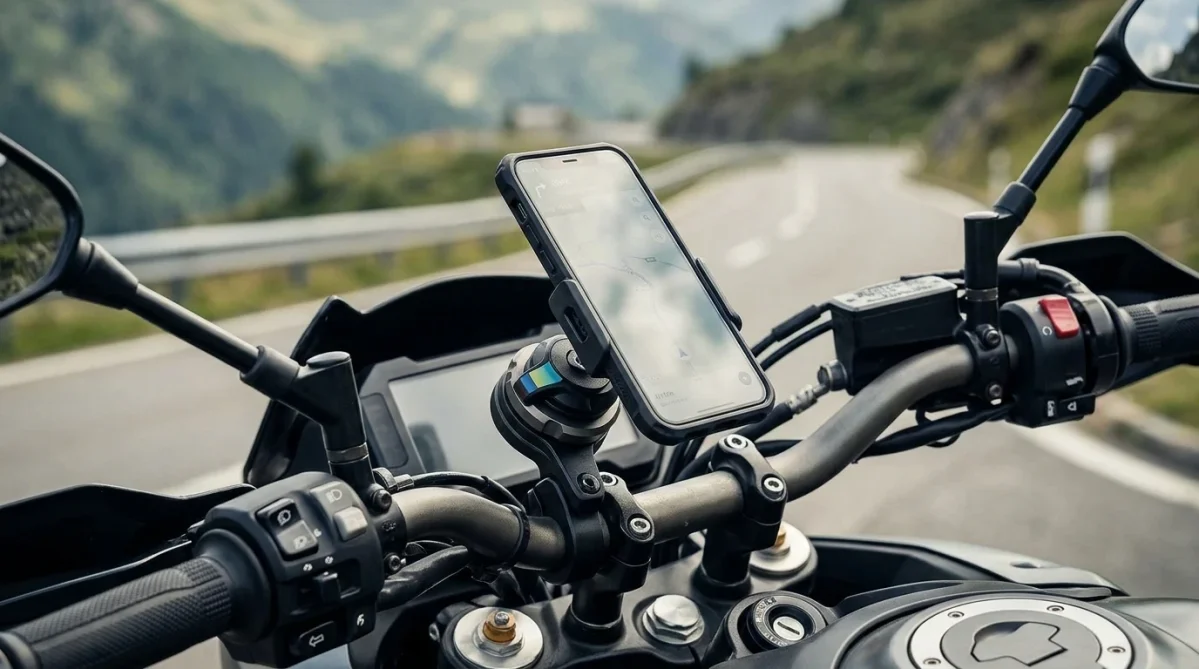
The Quad Lock Motorcycle Handlebar Mount is a strong all-around option for riders who regularly use their smartphones for navigation.
Its distinctive dual-stage locking mechanism allows a compatible phone case or adapter to attach securely to the mount.
Unlike universal clamp-style holders, Quad Lock uses a dedicated locking system designed to keep the phone attached during normal riding conditions.
Why It’s Worth Considering
- Dual-stage locking mechanism
- Multiple motorcycle mounting configurations
- Compatible vibration dampener available
- Optional charging accessories
- Quick phone attachment and removal
- Clean, relatively compact design
Quad Lock offers different mounting options for motorcycles with traditional handlebars, oversized handlebars, and other mounting locations.
Its optional vibration dampener is particularly worth considering because prolonged motorcycle vibration can damage sensitive smartphone camera components.
Things to Consider
The system generally requires a compatible Quad Lock phone case or universal adapter.
The vibration dampener and charging accessories may also add to the overall cost.
Riders should confirm that their chosen mount fits their motorcycle and that the complete setup provides adequate clearance around the controls.
Our Take: The Quad Lock system is for riders who want secure mounting, easy phone removal, and room to add accessories later.
2. RAM Mounts Quick-Grip — Best for Flexible Phone Compatibility
Best For: Riders who want an adjustable phone holder that accommodates different smartphone models without requiring a dedicated mounting case.
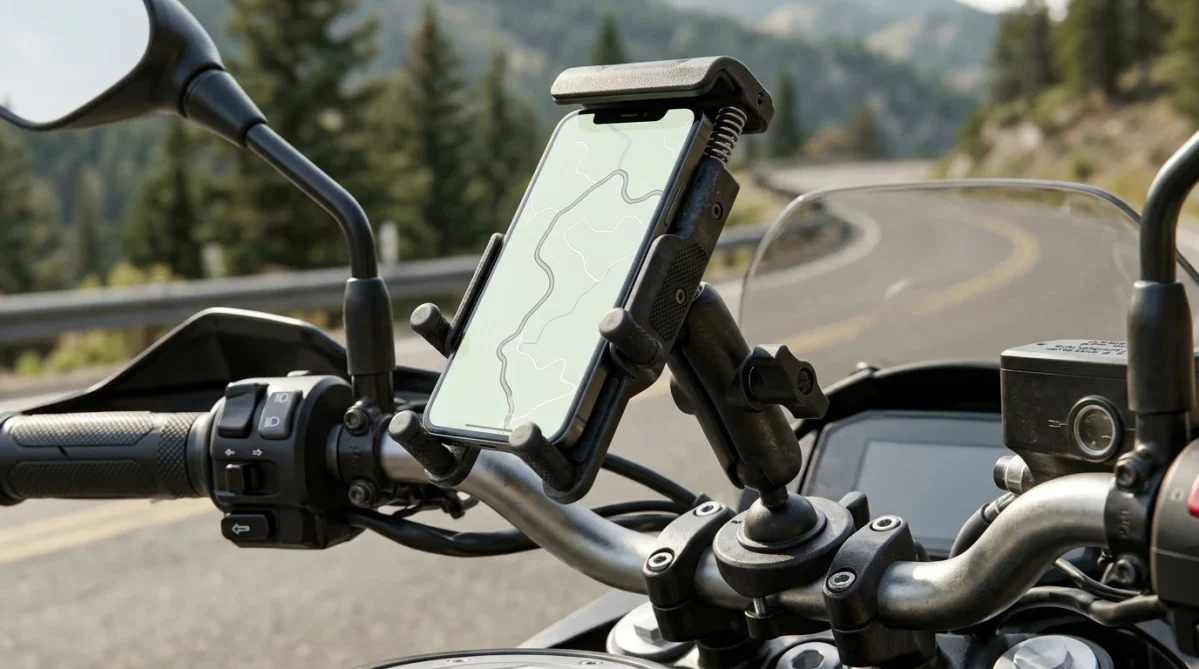
The RAM Mounts Quick-Grip offers a different approach to mounting a phone on a motorcycle.
Instead of relying on a proprietary locking case, it uses a spring-loaded holder with adjustable side supports to accommodate compatible smartphones.
This design suits riders who change phones often or prefer to keep their existing phone cases.
Why It’s Worth Considering
- Spring-loaded phone holder
- Adjustable side supports
- Compatible with a range of smartphone sizes
- Multiple mounting configurations
- Adjustable ball-and-socket mounting system
- Durable construction materials
The Quick-Grip is available in several configurations, including handlebar-mounted versions.
Its adjustable mounting system allows riders to position their phones according to available space and viewing preferences.
Things to Consider
Not every phone will fit every Quick-Grip holder, particularly when bulky protective cases are involved.
Riders should check the holder’s published dimensions before purchasing.
Vibration protection also deserves attention. RAM offers compatible Vibe-Safe mounting configurations for riders concerned about motorcycle vibration.
Our Take: The RAM Quick-Grip is worth considering for riders who prioritize flexible phone compatibility and adjustable mounting positions.
3. SP Connect Moto Mount Pro — Best for Adjustability
Best For: Riders who want a premium handlebar-mounted phone system with flexible positioning and compatible vibration-control accessories.
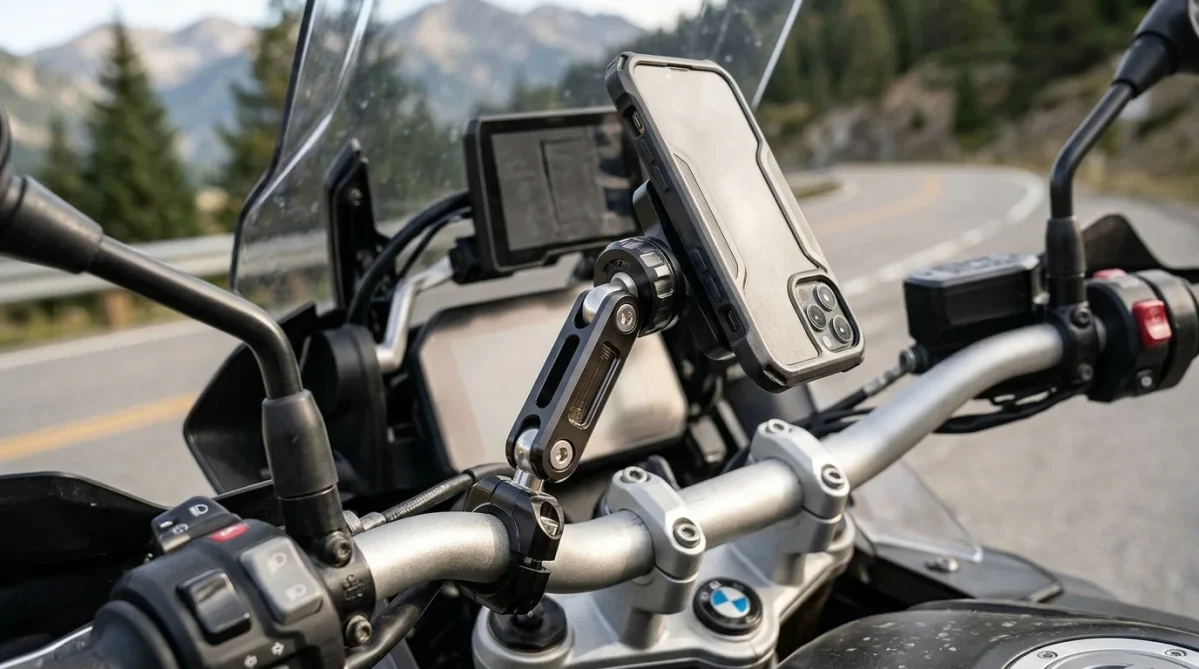
The SP Connect Moto Mount Pro is another motorcycle-specific mounting solution designed to provide a secure connection between a smartphone and the motorcycle.
Its adjustable design allows riders to position a compatible phone in portrait or landscape orientation.
The mount uses a machined aluminum construction and supports several common handlebar sizes.
Why It’s Worth Considering
- Adjustable mounting position
- Aluminum construction
- Compatible with standard and oversized handlebars
- Portrait and landscape positioning
- Compatible SP Connect phone cases and adapters
- Optional anti-vibration module
- Additional charging accessories available
The Moto Mount Pro is especially appealing to riders who want flexibility when positioning their phones around existing motorcycle controls and instruments.
SP Connect also offers an Anti-Vibration Module designed to reduce vibration transmitted to the smartphone.
Things to Consider
The system requires compatible SP Connect mounting accessories.
Depending on the setup, vibration protection and charging equipment may involve additional purchases.
As with any motorcycle phone mount, riders should verify handlebar compatibility and ensure that the installed phone does not obstruct instruments or controls.
Our Take: The SP Connect Moto Mount Pro is a strong alternative for riders who want an adjustable, motorcycle-focused mounting system with optional accessories.
What to Look for in a Motorcycle Phone Mount
Before choosing a phone mount, consider the following factors:
- Mounting location: Make sure the mount fits your handlebars, fork stem, or another suitable mounting point.
- Phone compatibility: Check the dimensions of your phone, including its protective case.
- Vibration protection: Consider a compatible vibration-dampening system, especially when using a smartphone with sensitive camera components.
- Mounting security: Look for a dependable retention system and follow the manufacturer’s installation instructions.
- Adjustability: Choose a mount that allows a useful viewing position without blocking essential controls.
- Charging options: Consider whether you need wired or wireless charging for longer rides.
- Weather exposure: Remember that a phone mount does not automatically make your smartphone waterproof.
Which Motorcycle Phone Mount Should You Choose?
The Quad Lock Motorcycle Handlebar Mount is our overall recommendation for riders who want a dedicated locking system and a broad range of accessories.
The RAM Mounts Quick-Grip is a practical alternative for riders who prefer a universal-style holder.
The SP Connect Moto Mount Pro deserves consideration if adjustable positioning and a premium mounting system are priorities.
One important caution: motorcycle vibration can damage certain smartphone cameras. Even a vibration-dampening accessory cannot guarantee complete protection. Check your phone manufacturer’s guidance before mounting an expensive smartphone, and consider a dedicated navigation device if vibration exposure is a major concern.
The best motorcycle phone mount fits your motorcycle, holds your phone securely, and allows you to follow navigation without distracting you from the road.
Best Motorcycle USB Chargers
A dependable USB charging system can be one of the most practical upgrades for riders who regularly use smartphones, GPS devices, or other electronics.
Whether you’re commuting, exploring unfamiliar roads, or traveling across several states, having a convenient power source can help keep your devices charged throughout the ride.
However, not all motorcycle USB chargers are the same. Charging connections, weather protection, installation requirements, and battery-drain prevention can make a significant difference.
Here are three motorcycle charging solutions worth considering in 2026.
1. OptiMate USB O-108 — Best for Everyday Charging
Best For: Riders who want a straightforward, weather-resistant USB-A charging solution with built-in motorcycle battery protection.
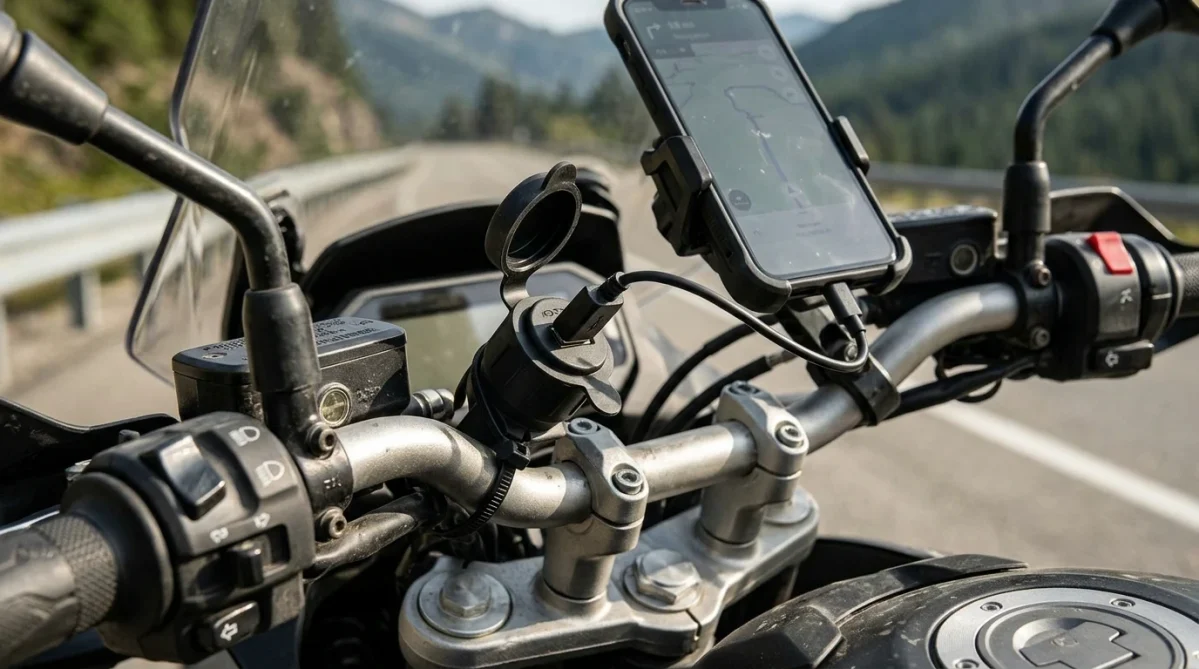
The OptiMate USB O-108 conveniently charges smartphones, navigation devices, and other compatible USB-powered electronics.
Its sealed, inline design makes it suitable for motorcycle installations where the charging connection may be exposed to changing weather conditions.
Why It’s Worth Considering
- Single USB-A charging connection
- Up to 3.3 amps at 5 volts
- SAE two-pin power connection
- Weather-resistant charging-port design
- Automatic battery-drain protection
- Battery-status monitoring
- Protection against short circuits, overheating, and overvoltage
One particularly useful feature is the automatic standby system, which monitors battery voltage and reduces the risk of draining the motorcycle battery while parked.
The charger can be positioned near the handlebars or routed toward a tank bag or luggage compartment.
Things to Consider
The O-108 provides one USB-A charging connection rather than a built-in USB-C port.
Riders using newer USB-C devices will need the proper charging cable, and the charger’s output may not support the fastest charging modes available on some smartphones.
An SAE battery connection must also be available. If your motorcycle doesn’t already have one, you will need a compatible fused battery lead.
Our Take: The OptiMate O-108 is a practical choice for everyday riders who want dependable charging without installing a complicated electrical system.
2. OptiMate USB O-118 — Best for USB-C Convenience
Best For: Riders who prefer a dedicated USB-C charging connection for compatible smartphones and electronic devices.
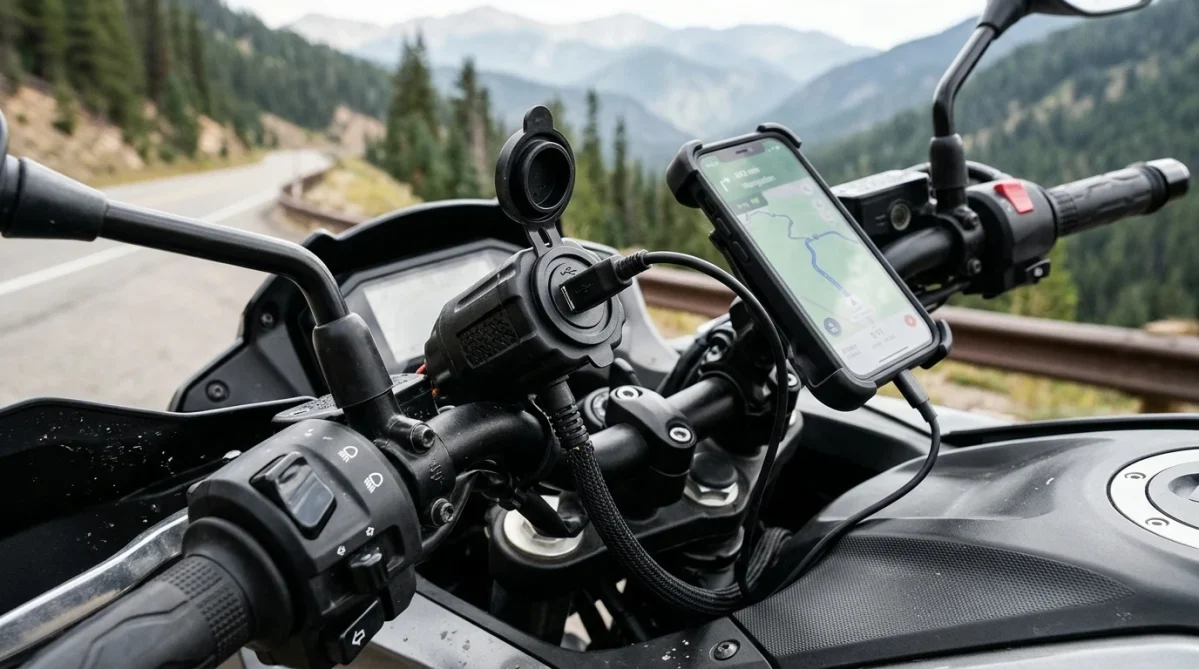
The OptiMate USB O-118 offers a similar approach to motorcycle charging but uses a USB-C connection.
It is designed for permanent installation and includes a fused battery connection.
For riders who primarily use USB-C devices, this can eliminate the need for a separate USB-A charging cable.
Why It’s Worth Considering
- Dedicated USB-C charging connection
- Up to 3.3 amps at 5 volts
- Fused battery connection
- Weather-resistant design
- Automatic charging control
- Battery-voltage monitoring
- Built-in battery-drain protection
The O-118 is particularly useful for riders who want a dedicated charging cable routed to a convenient location.
Its automatic operation also helps reduce the likelihood of accidentally leaving a connected device drawing power from a parked motorcycle.
Things to Consider
Although it uses USB-C, the O-118 is not a high-wattage USB Power Delivery charger.
Riders who need faster charging for demanding devices should compare the charger’s electrical output with their device’s requirements.
The charger also requires a suitable battery connection and careful cable routing.
Our Take: The OptiMate O-118 is a convenient option for riders who primarily use USB-C devices and want a motorcycle-specific charging system with battery protection.
3. Quad Lock Waterproof 12V to USB Smart Adaptor — Best for Integrated Phone Charging
Best For: Riders using a Quad Lock motorcycle phone mount who want to add a compatible wireless charging system.
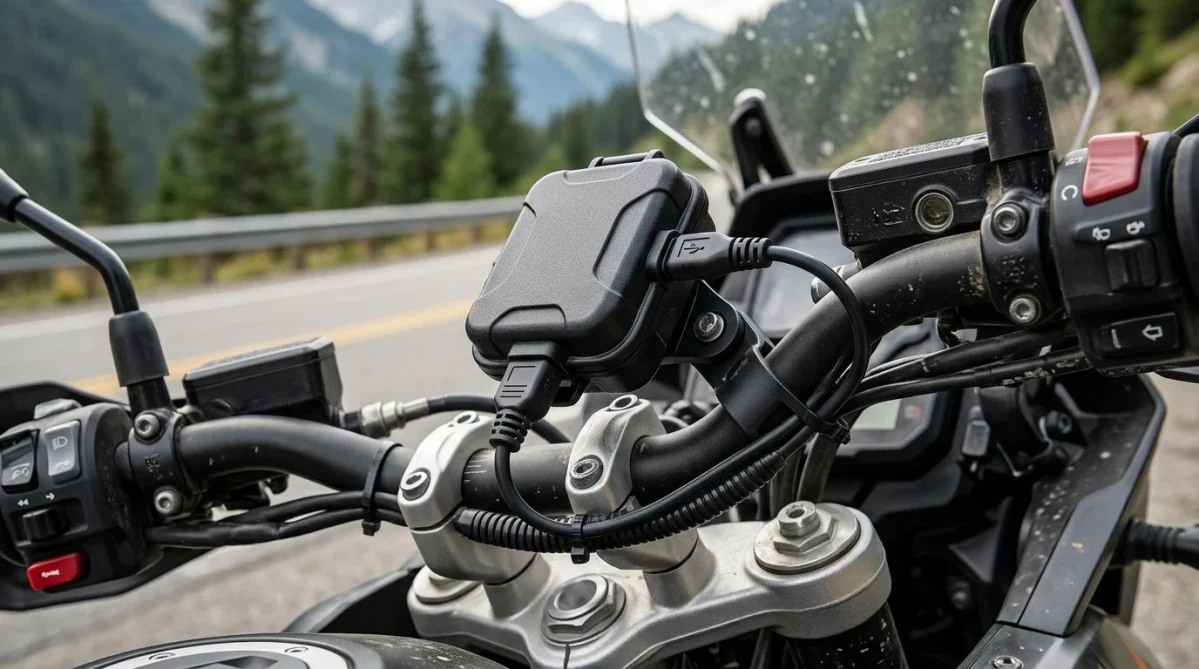
The Quad Lock Waterproof 12V to USB Smart Adaptor was designed to supply power to Quad Lock’s compatible waterproof wireless charging equipment.
Instead of functioning as a conventional handlebar-mounted USB socket, it provides a protected electrical connection between the motorcycle and a compatible charging accessory.
This makes it especially appealing to riders who already use the Quad Lock mounting system.
Why It’s Worth Considering
- Supports 12V–24V DC input
- USB-A output rated up to 18 watts
- On, Off, and Auto switching modes
- Automatic voltage-based switching
- Reverse-polarity protection
- Inline fuse
- IP66-rated adaptor housing
- Compatible with Quad Lock’s waterproof wireless charging system
The automatic switching mode is particularly useful because it stops supplying power when motorcycle battery voltage falls below a specified threshold.
The adaptor also includes wiring components intended to simplify installation.
Things to Consider
The adaptor does not include the wireless charging head or phone mount, which must be purchased separately, increasing the total system cost.
Its primary purpose is powering compatible Quad Lock charging equipment, so riders seeking a general-purpose USB charging port may find a dedicated motorcycle USB charger more appropriate.
Quad Lock also notes that the automatic switching function may not behave as intended with some lithium motorcycle batteries. In those installations, the manufacturer recommends using manual switching to prevent battery drain.
Our Take: The Quad Lock Smart Adaptor is worth considering for riders who want to integrate charging into an existing Quad Lock phone mounting setup.
What to Look for in a Motorcycle USB Charger
Before purchasing a motorcycle USB charging system, consider the following factors:
- Charging connection: Determine whether your devices require USB-A, USB-C, or wireless charging.
- Power output: Compare the charger’s voltage, current, and supported charging standards with your device’s requirements.
- Weather protection: Look for appropriate sealing and protection against rain and road spray.
- Battery protection: Choose a charger with automatic shutoff or connect it to an appropriately switched circuit.
- Installation requirements: Verify whether the system uses an SAE connector, battery terminals, or an existing accessory power connection.
- Fuse protection: Follow the manufacturer’s instructions for circuit protection and wiring.
- Cable placement: Keep wiring clear of steering movement, hot engine components, and moving parts.
- Device compatibility: Confirm that your phone or navigation device supports the charger’s available output.
For permanent electrical installations, riders unfamiliar with motorcycle wiring should consider professional assistance.
Which Motorcycle USB Charger Should You Choose?
I recommend the OptiMate O-108 for riders who want a straightforward USB-A charging solution with useful battery protection.
The OptiMate O-118 is a practical alternative for riders who prefer a dedicated USB-C connection.
The Quad Lock Waterproof 12V to USB Smart Adaptor makes the most sense for riders who want to power a compatible Quad Lock wireless charging setup.
Regardless of which system you choose, proper installation and electrical compatibility are essential.
The best motorcycle USB charger reliably powers your devices, fits your motorcycle’s electrical system, and doesn’t cause unnecessary battery drain or wiring problems.
Best Motorcycle Bluetooth Communication Systems
A motorcycle Bluetooth communication system makes riding with a passenger or a group more convenient. These helmet-mounted devices allow riders to communicate, hear navigation instructions, and listen to audio without relying on handheld equipment.
For touring riders, communication systems can be especially useful when coordinating fuel stops, discussing route changes, or staying in contact with riding partners.
However, not every system offers the same communication range, group capacity, helmet compatibility, or audio features.
Here are three motorcycle communication systems worth considering in 2026.
1. Cardo Packtalk Edge — Best for Group Riding
Best For: Riders who frequently travel in groups and want a premium communication system with mesh networking, voice controls, and convenient helmet mounting.
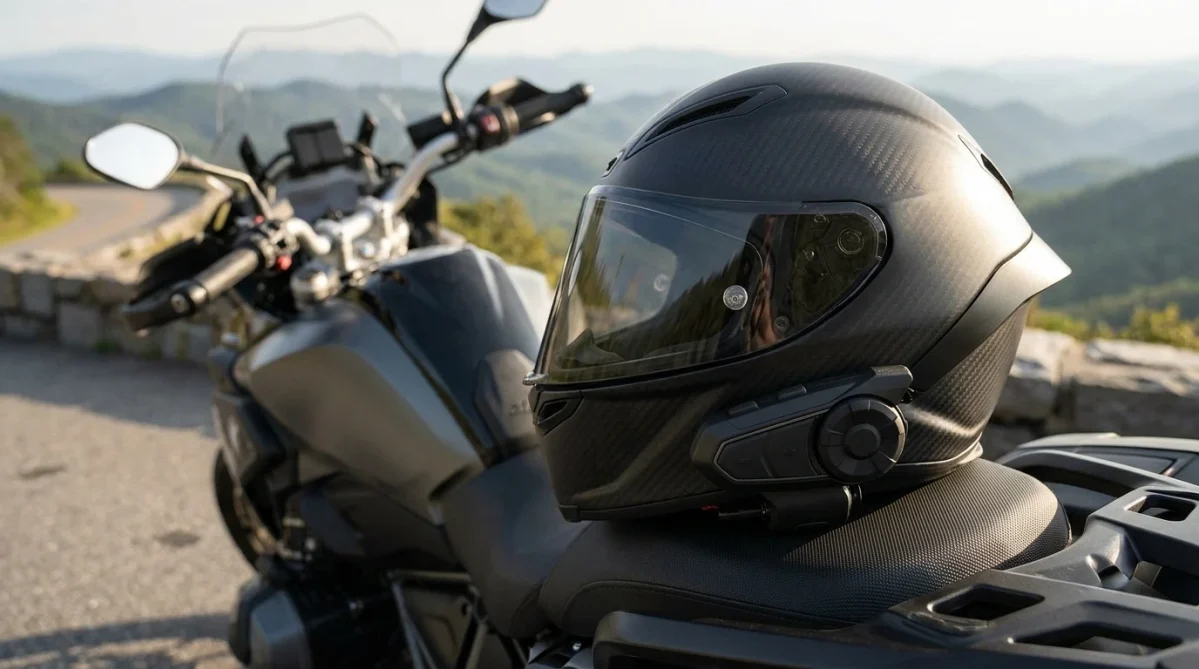
The Cardo Packtalk Edge is a premium motorcycle communication system designed for riders who want reliable group connectivity and a broad range of features.
Its second-generation Dynamic Mesh Communication (DMC) system allows compatible units to maintain a group network and automatically reconnect when riders move out of range and return.
This makes it particularly appealing for motorcycle touring groups where riders may become temporarily separated.
Why It’s Worth Considering
- Second-generation Dynamic Mesh Communication
- Supports groups of up to 31 riders
- Manufacturer-rated range of up to 1 mile between compatible units
- JBL audio system
- Natural voice operation
- Magnetic Air Mount attachment system
- IP67 waterproof rating
- Over-the-air software updates
- Bluetooth connectivity for compatible devices
The magnetic Air Mount is a convenient feature because you can attach and detach the communication unit from its helmet-mounted cradle.
Natural voice operation also reduces the need to reach for physical controls while riding.
Things to Consider
The Packtalk Edge is a premium product, so its cost may be difficult to justify for riders who rarely communicate with others.
Its mesh communication advantages are most useful when riding with other compatible systems.
Although Cardo offers cross-brand connectivity options, riders should verify which communication features will work with their group’s existing equipment.
Actual communication range will also vary with terrain, obstacles, and riding conditions.
My Take: I recommend the Cardo Packtalk Edge for riders who prioritize group communication, convenient controls, and a premium feature set.
2. Sena 50S — Best for Flexible Mesh Communication
Best For: Riders who want a feature-rich communication system with mesh networking, Bluetooth intercom capability, and convenient physical controls.
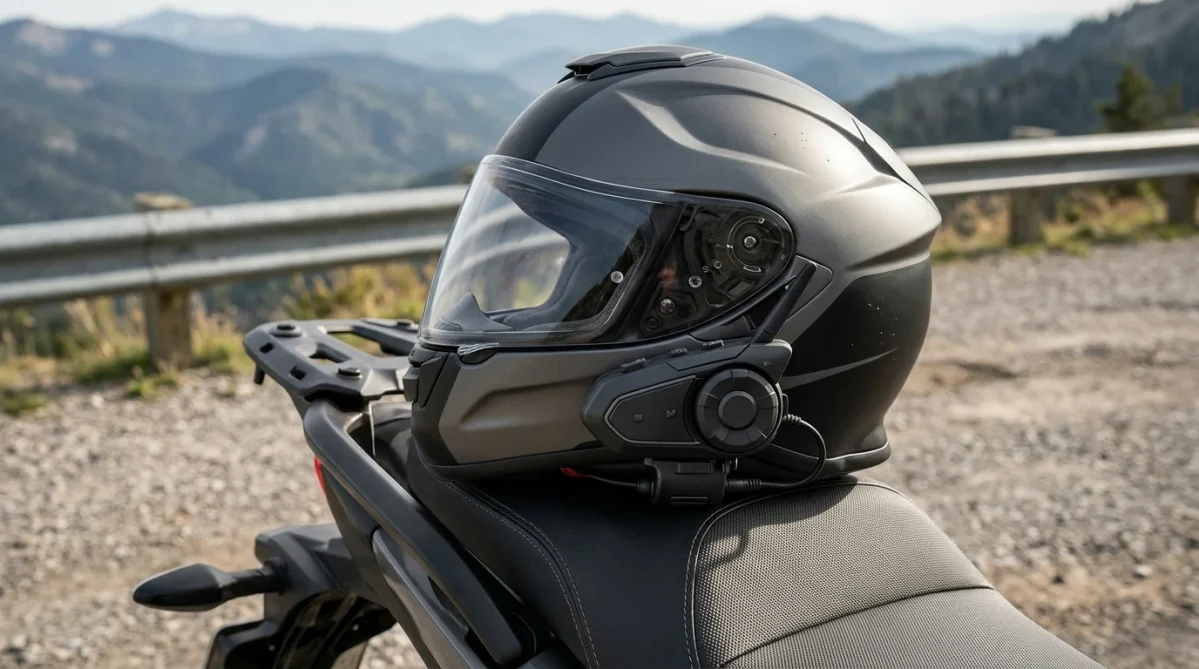
The Sena 50S is a premium helmet communication system that combines mesh intercom technology with conventional Bluetooth connectivity.
Its Mesh Intercom system allows riders with compatible Sena equipment to communicate in an open network or a private group.
The 50S also features a jog-dial control, which some riders may find easier to operate with gloves than smaller buttons.
Why It’s Worth Considering
- Mesh Intercom technology
- Open Mesh and private Group Mesh communication options
- Bluetooth intercom support for up to four riders
- Private Group Mesh support for up to 24 participants
- Manufacturer-rated intercom range of up to 1.2 miles in open terrain
- Audio system developed with Harman Kardon
- Advanced Noise Control
- Jog-dial interface
- Smartphone app for settings and updates
- FM radio functionality
The combination of mesh and Bluetooth communication gives riders flexibility when traveling with different groups.
Sena also provides app-based settings that allow users to customize certain audio and communication features.
Things to Consider
The Sena 50S includes numerous features that may require some time to learn and configure.
Its full capabilities depend on the communication systems used by other riders.
Riders should also confirm that the speakers, microphone, and mounting hardware are compatible with their helmets.
As with other intercom systems, advertised communication ranges represent favorable conditions rather than guaranteed real-world distances.
Our Take: The Sena 50S is a strong option for riders who want mesh communication, multiple connectivity choices, and a familiar jog-dial control system.
3. Cardo Freecom 4X — Best for Small Riding Groups
Best For: Solo riders, riding partners, and smaller groups who want useful Bluetooth communication features without investing in a premium mesh system.
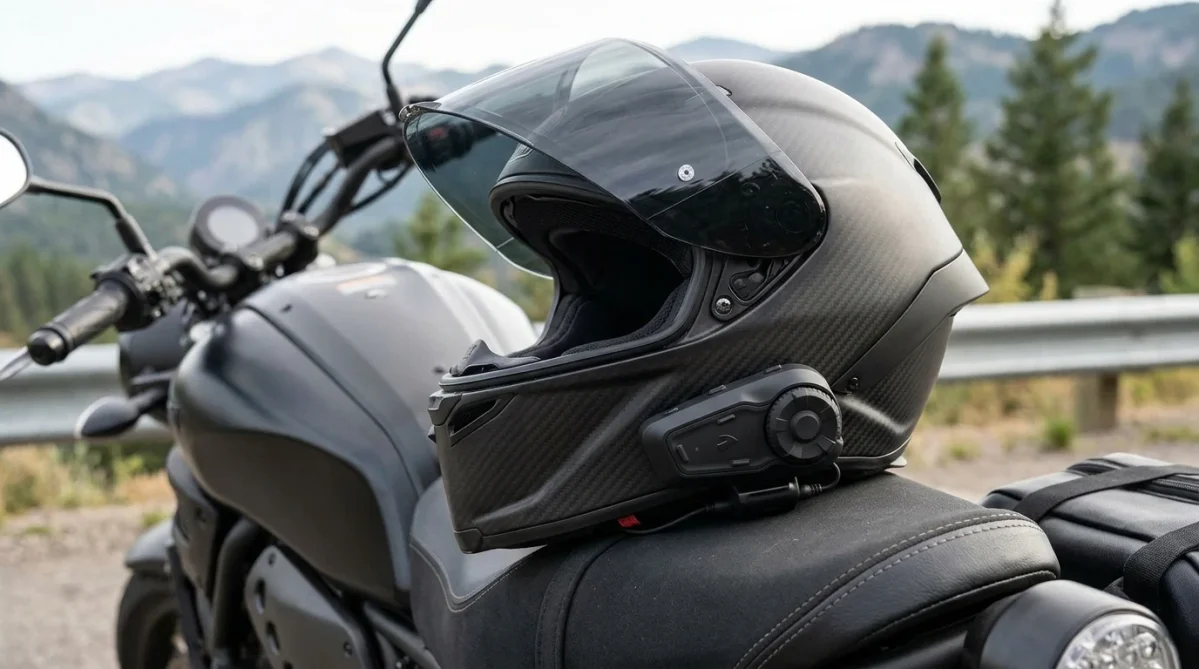
The Cardo Freecom 4X is designed around Bluetooth intercom communication rather than the larger mesh networks offered by premium systems.
It supports communication among up to four riders and includes features such as JBL audio, natural voice operation, and automatic reconnection.
For riders who typically travel alone, with a passenger, or with a few friends, the Freecom 4X offers an appealing balance of capability and simplicity.
Why It’s Worth Considering
- Bluetooth intercom for up to four riders
- Manufacturer-rated range of up to 0.75 miles
- Live Bluetooth Intercom with automatic reconnection
- JBL 40mm speakers
- Natural voice operation
- Waterproof construction
- Over-the-air software updates
- Smartphone connectivity
- FM radio
- Cross-brand Bluetooth connectivity options
The Freecom 4X provides many of the everyday features riders want without requiring them to pay for a more advanced mesh communication system.
Its voice controls can also make it easier to manage certain functions while keeping both hands on the handlebars.
Things to Consider
Unlike the Packtalk Edge, the Freecom 4X does not provide Dynamic Mesh Communication.
Its four-rider Bluetooth intercom capacity may be limiting for larger riding groups.
Actual range and connection stability depend on terrain, distance between riders, and other conditions.
Riders should also verify helmet compatibility and check whether their preferred communication partners use compatible systems.
Our Take: The Cardo Freecom 4X is a practical choice for riders who want dependable everyday communication features without paying for capabilities they may rarely use.
What to Look for in a Motorcycle Communication System
Before purchasing a helmet communication system, consider the following factors:
- Riding group size: Determine whether you usually ride alone, with one partner, or in a larger group.
- Bluetooth versus mesh: Bluetooth systems may be good enough for small groups, while mesh networking offers advantages for larger groups using compatible equipment.
- Helmet compatibility: Confirm that the system can be installed correctly without compromising helmet fit or safety.
- Communication range: Treat manufacturer range figures as estimates under favorable conditions.
- Battery life: Consider how long you typically ride between charging opportunities.
- Audio quality: Look at speaker design, microphone performance, and noise-management features.
- Ease of operation: Controls should be manageable with gloves and should not require unnecessary attention while riding.
- Weather resistance: Choose equipment suitable for the conditions you expect to encounter.
- Cross-brand compatibility: Check the specific features supported when connecting different brands or models.
Remember that helmet speakers and communication systems should not prevent you from hearing important traffic sounds. Keep audio at a reasonable volume, minimize distractions, and follow applicable local laws.
Which Motorcycle Communication System Should You Choose?
The Cardo Packtalk Edge is our overall recommendation for riders who frequently travel in larger groups and want advanced mesh networking.
The Sena 50S is an appealing alternative for riders who prefer Sena’s communication ecosystem and want both mesh and Bluetooth options.
The Cardo Freecom 4X makes the most sense for solo riders, passengers, and smaller groups who do not need premium mesh capabilities.
Before purchasing, consider which systems your regular riding partners already use. Choosing compatible equipment can be more valuable than selecting a product solely because it has the longest list of features.
The best motorcycle communication system works with your helmet, connects with the people you ride alongside, and allows you to communicate without taking your attention away from riding.
Best Motorcycle Luggage and Storage Accessories
Motorcycle luggage can make a significant difference in everyday convenience and long-distance travel. Whether you’re carrying a wallet and rain gloves or packing for several days on the road, the right storage system helps keep your belongings organized and securely attached to your motorcycle.
Planning a longer motorcycle adventure? Our Smoky Mountains Motorcycle Trip Planning Guide covers practical considerations for preparing your next mountain ride, including what to plan before heading out.
The challenge is choosing luggage that provides enough capacity without interfering with handling, passenger comfort, or access to important controls.
Here are three motorcycle luggage options worth considering in 2026.
1. GIVI ST611+ TANKLOCK Tank Bag — Best for Everyday Essentials
Best For: Riders who want convenient access to smaller belongings during commuting, day trips, and recreational rides.
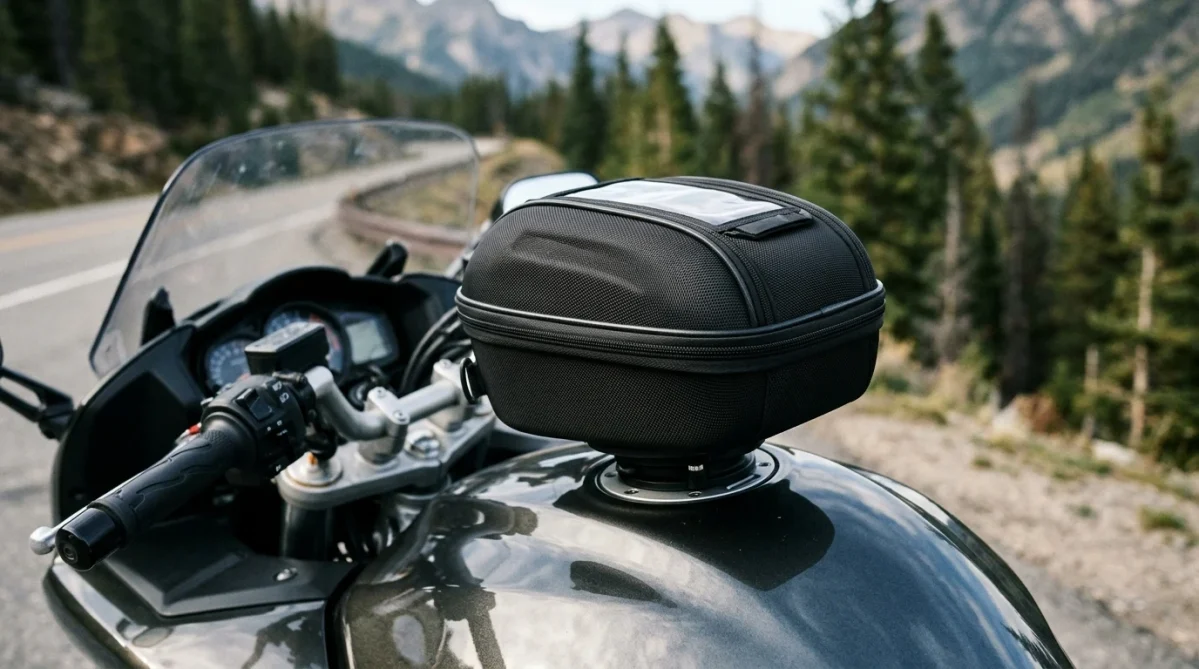
The GIVI ST611+ is a compact six-liter tank bag designed to attach through GIVI’s TANKLOCK mounting system.
Unlike traditional magnetic or strap-mounted tank bags, the TANKLOCK system uses a motorcycle-specific mounting flange attached around the fuel filler.
This provides a convenient way to attach and remove the bag without placing its full weight directly on the painted fuel tank.
Why It’s Worth Considering
- Six-liter storage capacity
- TANKLOCK quick-attachment system
- Semi-rigid construction
- Water-resistant rain cover included
- Smartphone storage window
- Internal storage pocket
- Charging-cable access
- Reflective details
- Carrying handle and shoulder strap
The ST611+ is particularly useful for carrying smaller items such as a wallet, sunglasses, charging cables, and other essentials you may want to access during stops.
Its compact size also makes it appealing to riders who don’t need large luggage for every trip.
Things to Consider
The ST611+ requires a compatible GIVI TANKLOCK flange, which is sold separately.
Not every motorcycle supports the same mounting hardware, so riders should verify fitment before purchasing.
Its six-liter capacity is also relatively limited, making it less suitable for bulky clothing or overnight equipment.
Although a rain cover is included, riders should use additional waterproof protection for electronics and other moisture-sensitive belongings when necessary.
Our Take: The GIVI ST611+ is a practical option for riders who want organized, easily removable storage for everyday essentials.
2. Kriega OS-18 Adventure Pack — Best for Waterproof Soft Luggage
Best For: Touring and adventure riders who want durable, waterproof storage with flexible mounting options.
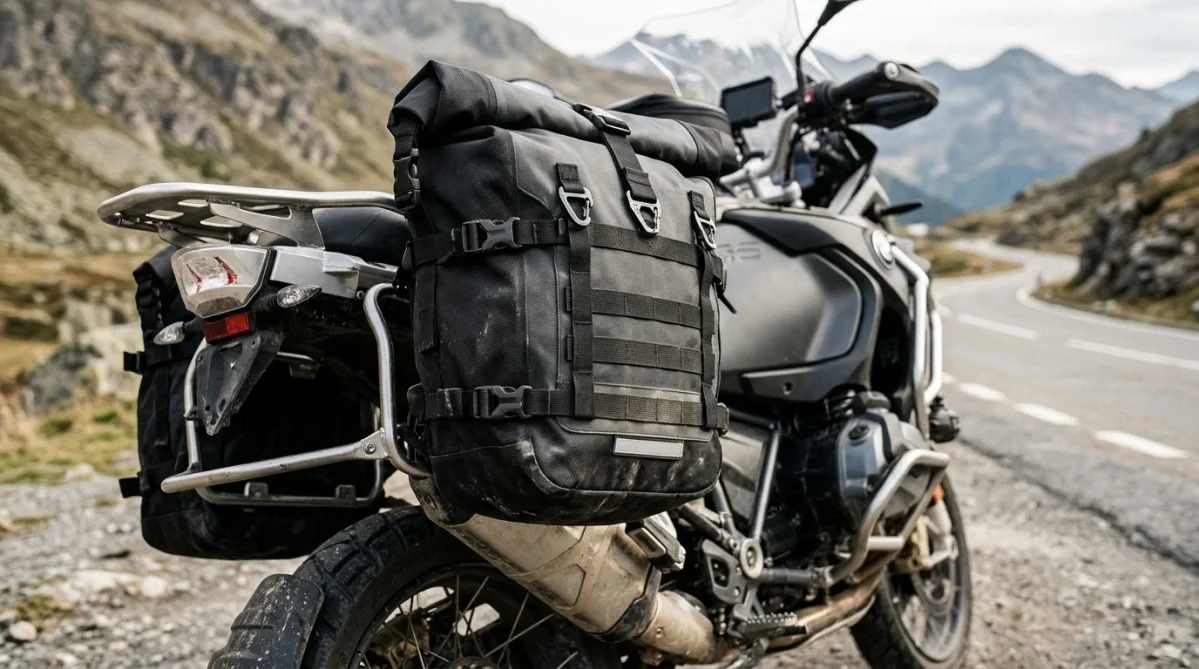
The Kriega OS-18 Adventure Pack is an 18-liter soft luggage bag designed for motorcycle travel in changing weather and road conditions.
Its roll-top closure and waterproof removable liner help protect belongings from rain and road spray.
The OS-18 can be used in different luggage configurations, including mounting to compatible rear racks, pannier frames, or Kriega’s OS luggage systems.
Why It’s Worth Considering
- 18-liter storage capacity
- Waterproof roll-top design
- Removable waterproof liner
- Heavy-duty Hypalon and 1000D Cordura construction
- Reinforced attachment points
- Durable alloy and acetal hardware
- Multiple mounting configurations
- High-visibility details
- Compatible with additional Kriega OS luggage accessories
The OS-18 is particularly appealing to riders who travel in unpredictable weather or want a flexible luggage system that can grow with their needs.
Its soft-sided construction also provides an alternative to rigid panniers and top cases.
Things to Consider
The OS-18 does not provide the same rigid structure or keyed locking security as a hard luggage case.
Depending on the motorcycle and intended mounting position, additional straps, rack loops, or mounting hardware may be necessary.
Riders should also verify that the installed bag cannot contact the exhaust, rear wheel, suspension, or other moving components.
Although its waterproof liner helps protect contents, proper closure and installation remain essential.
Our Take: The Kriega OS-18 is an appealing choice for riders who prioritize weather protection, durability, and flexible luggage arrangements.
3. SHAD SH39 Top Case — Best for Lockable Everyday Storage
Best For: Commuters and touring riders who want a removable, lockable storage compartment mounted behind the seat.
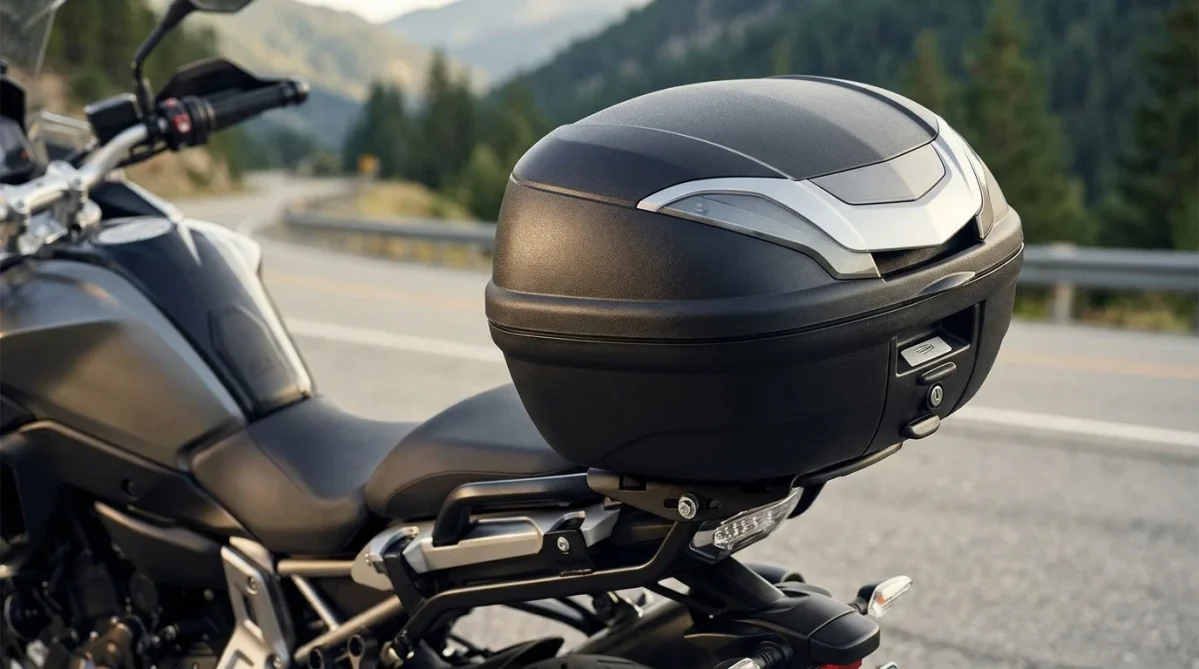
The SHAD SH39 is a 39-liter hard top case designed to provide convenient storage for helmets, riding accessories, and everyday belongings.
Its rigid construction and locking system make it useful for riders who want more secure storage than an open or soft-sided bag can provide.
SHAD includes a universal mounting baseplate, although motorcycle-specific mounting hardware may still be required.
Why It’s Worth Considering
- 39-liter storage capacity
- Rigid hard-case construction
- Key-operated locking system
- Removable case design
- Universal baseplate included
- Integrated rear reflector
- Rubber gasket to help limit water and dust entry
- Optional passenger backrest
- Optional brake-light accessory
SHAD states that the case can accommodate a full-face helmet and an open-face helmet, depending on their dimensions.
For commuters, the SH39 offers a convenient place to store smaller personal items when the motorcycle is parked.
It can also provide additional carrying capacity for weekend trips.
Things to Consider
The SH39 requires a suitable rear rack or compatible motorcycle-specific mounting kit.
Its manufacturer-recommended maximum load is 8.5 pounds, so riders should not assume the case can safely carry heavy equipment simply because it has a relatively large storage capacity.
The motorcycle’s rear rack and overall load limits must also be respected.
Although the case is lockable, it should not be treated as theft-proof. Valuable belongings are best removed when leaving the motorcycle unattended.
Our Take: The SHAD SH39 is a practical option for riders who want convenient, removable, lockable storage for commuting and recreational travel.
What to Look for in Motorcycle Luggage
Before purchasing motorcycle luggage, consider the following factors:
- Storage capacity: Choose a size that matches what you regularly carry rather than buying the largest available bag.
- Motorcycle compatibility: Verify mounting requirements for your specific motorcycle model and year.
- Weather protection: Understand the difference between water-resistant materials, rain covers, and waterproof liners.
- Mounting security: Ensure bags and cases remain securely attached under normal riding conditions.
- Weight limits: Follow the luggage manufacturer’s limits and the motorcycle manufacturer’s load recommendations.
- Passenger accommodations: Confirm that luggage does not interfere with passenger seating, footpegs, or comfort.
- Ease of removal: Consider whether you want to carry the luggage with you after parking.
- Security: Hard cases may offer convenient locking storage, while soft luggage often prioritizes flexibility and lower weight.
Regardless of the luggage type, distribute weight appropriately and inspect mounting hardware before longer trips.
Poorly secured or overloaded luggage can affect motorcycle handling and create unnecessary hazards.
Which Motorcycle Luggage Should You Choose?
The GIVI ST611+ TANKLOCK Tank Bag is my recommendation for riders who want compact storage for daily essentials.
The Kriega OS-18 Adventure Pack is particularly appealing for touring and adventure riders who prioritize waterproof protection and flexible mounting options.
The SHAD SH39 Top Case is worth considering for commuters and recreational riders who want a removable, lockable storage compartment.
These products serve different purposes, so the right choice depends on what you carry, where you ride, and how your motorcycle is equipped.
The best motorcycle luggage system provides useful storage without compromising secure mounting, proper weight distribution, or your motorcycle’s handling.
Best Motorcycle Windshields and Wind Protection
Wind protection can make a noticeable difference in motorcycle comfort, especially during highway travel and longer rides.
Constant wind pressure against your chest, shoulders, and helmet can contribute to fatigue. Depending on your motorcycle and riding position, a properly selected windshield may help reduce that exposure and make extended trips more comfortable.
However, a larger windshield isn’t always the better choice.
Windshield height, shape, mounting position, and airflow around the rider all influence comfort. A windshield that works well for one rider may create unwanted turbulence or helmet buffeting for another.
Here are three motorcycle wind protection options worth considering in 2026.
1. Puig Touring Windshield — Best for Touring Comfort
Best For: Riders who want increased wind coverage on a compatible motorcycle without making extensive modifications.
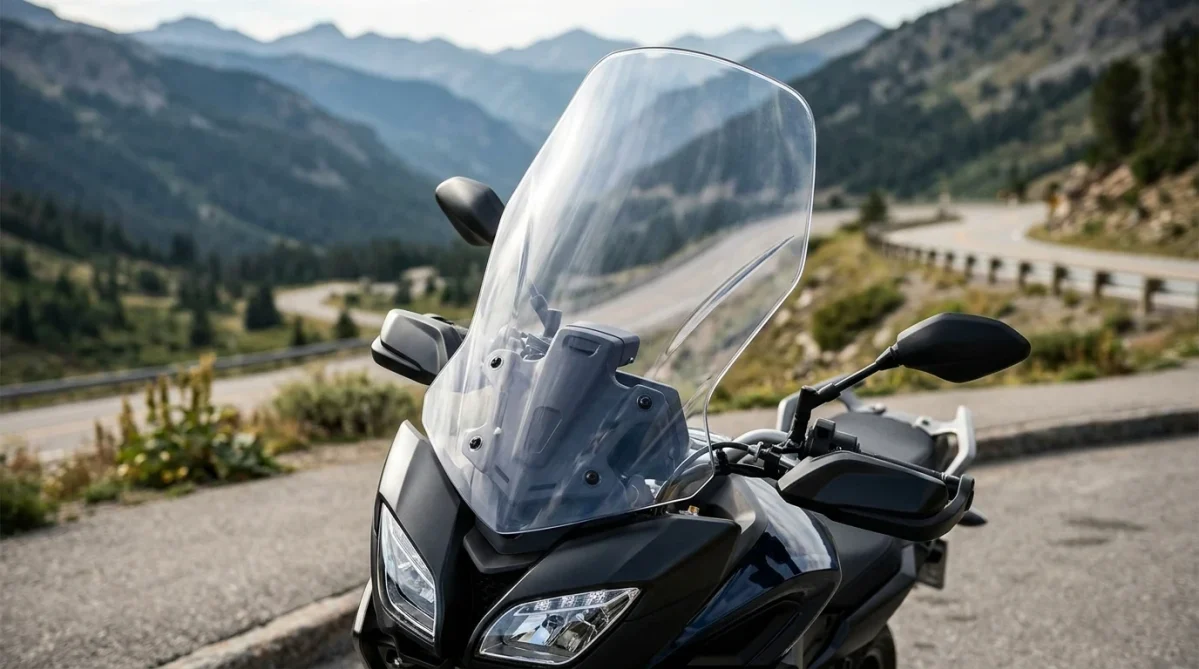
Puig touring windshields are designed for specific motorcycle models, including sport-touring, adventure, and other road-oriented motorcycles.
These windshields are generally designed to provide greater wind coverage than the motorcycle’s original screen, although the amount of additional protection varies by model.
For riders who spend considerable time on highways, a touring-style windshield can be a practical comfort upgrade.
Why It’s Worth Considering
- Motorcycle-specific windshield designs
- Increased wind coverage on many applications
- Durable acrylic construction on many models
- Clear and tinted options, depending on fitment
- Aerodynamic shapes intended to redirect airflow
- Installation using compatible mounting hardware
- Potential reduction in direct wind pressure
One advantage of Puig’s touring windshield range is the availability of designs tailored to particular motorcycles.
This can provide a more integrated appearance and fit than attempting to adapt a universal windshield.
Things to Consider
Puig touring windshields are not universal products.
Riders must select the correct windshield for their motorcycle’s make, model, and year.
A taller windshield may reduce direct wind pressure but can also change airflow around the helmet, sometimes increasing turbulence or noise.
Tinted windshields may also affect visibility, particularly in low-light conditions.
Our Take: A Puig Touring Windshield is worth considering for riders who want additional wind protection while maintaining a motorcycle-specific installation.
2. National Cycle VStream Windshield — Best for Managing Airflow
Best For: Touring and commuting riders who want a replacement windshield designed to redirect airflow around the rider.
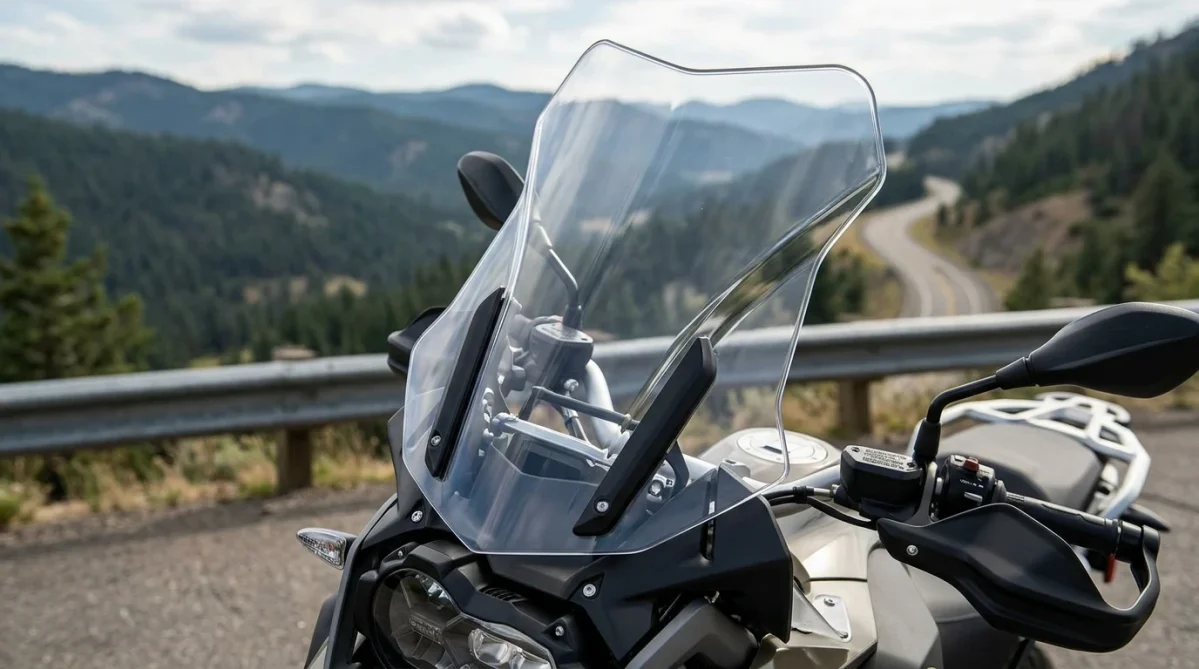
National Cycle’s VStream windshield series uses a distinctive V-shaped profile intended to manage airflow differently from a conventional windshield.
Rather than simply increasing windshield height, the design aims to redirect air outward and away from the rider’s upper body and helmet area.
This approach can be particularly appealing to riders who experience uncomfortable turbulence with their motorcycle’s original windshield.
Why It’s Worth Considering
- Distinctive V-shaped windshield profile
- Motorcycle-specific applications
- Polycarbonate construction on many models
- Scratch-resistant protective coating on applicable versions
- Different heights available for certain motorcycles
- Designed to redirect airflow away from the rider
- Replacement options for selected touring and adventure motorcycles
The VStream design is intended to provide a broader area of calmer airflow behind the windshield.
Depending on the motorcycle and rider’s height, this may help improve highway comfort.
Things to Consider
VStream windshields are available only for supported motorcycles.
The correct height is important because rider height, seating position, and helmet placement affect how air moves around the windshield.
Even a windshield designed to reduce turbulence cannot guarantee a quiet or buffeting-free ride.
Riders should also verify whether a particular model requires additional mounting hardware.
Our Take: The National Cycle VStream is an appealing option for riders who want a motorcycle-specific windshield that emphasizes airflow management rather than size alone.
3. MRA X-Creen Touring Spoiler — Best for Adjustable Wind Deflection
Best For: Riders who want to adjust airflow around an existing windshield without replacing the entire screen.
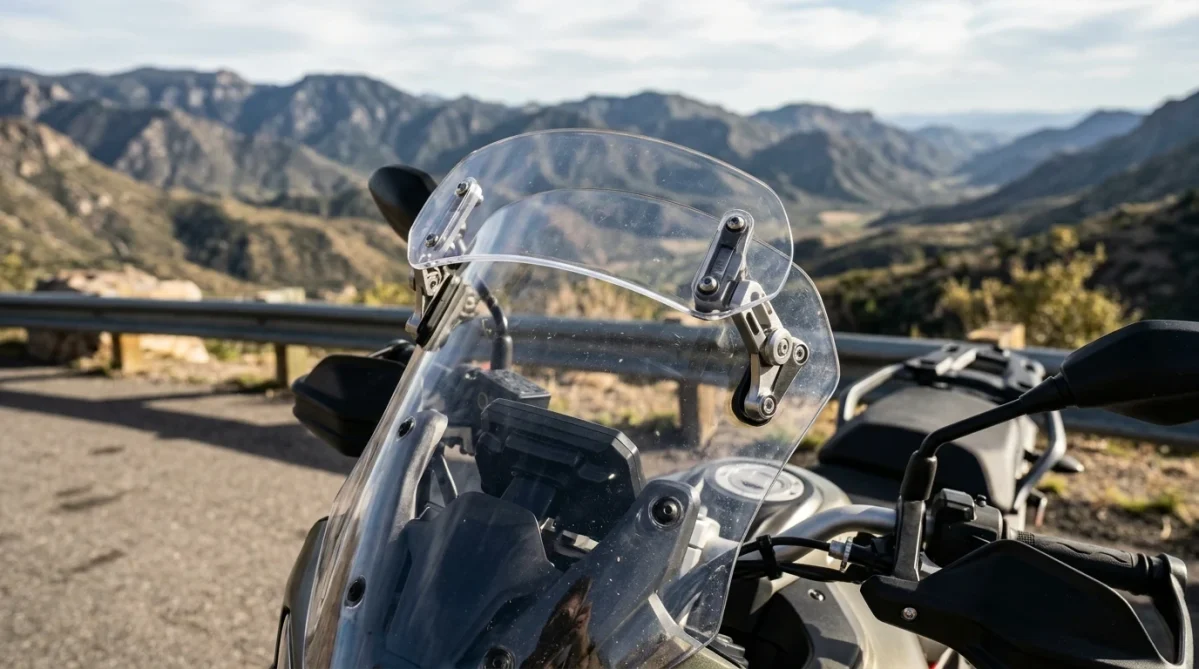
The MRA X-Creen Touring Spoiler is an adjustable wind deflector designed to attach to a compatible motorcycle windshield.
Instead of replacing the original windshield, the X-Creen adds a secondary aerodynamic surface that can be adjusted to influence airflow.
This can be useful for riders who are generally satisfied with their existing windshield but want to experiment with additional wind protection.
Why It’s Worth Considering
- Adjustable spoiler position
- Designed to work with compatible existing windshields
- Multiple adjustment possibilities
- Available mounting configurations
- Can help redirect airflow above the original screen
- Less extensive modification than replacing a complete windshield
- Useful for fine-tuning wind protection
The X-Creen’s main advantage is adjustability.
Riders can experiment with different positions to find a configuration that provides a more comfortable balance between wind protection and airflow.
Things to Consider
The spoiler must be compatible with the existing windshield’s shape, dimensions, and construction.
Some mounting configurations require drilling, while clamp-style mounting options may be available separately or as part of a specific kit.
Proper installation is essential because an incorrectly mounted spoiler could loosen or interfere with visibility.
The additional height may also affect sightlines, depending on the rider’s seating position.
Our Take: The MRA X-Creen Touring Spoiler is a practical option for riders who want to fine-tune wind protection without immediately investing in a replacement windshield.
What to Look for in a Motorcycle Windshield
Before purchasing a motorcycle windshield or wind deflector, consider the following factors:
- Motorcycle compatibility: Verify that the product fits your specific motorcycle model and year.
- Windshield height: Consider your seated eye level and whether you prefer looking over or through the screen.
- Riding position: Upright touring positions and forward-leaning sport positions can require different airflow solutions.
- Wind turbulence: A taller windshield may not always reduce helmet buffeting.
- Material quality: Look for durable materials and appropriate protective coatings.
- Adjustability: Adjustable screens or spoilers can help accommodate different riders and riding conditions.
- Visibility: Ensure the windshield does not create distracting distortion or obstruct your view.
- Installation requirements: Check whether additional brackets, clamps, or motorcycle-specific hardware are needed.
Windshield performance can also change when riding with a passenger, carrying luggage, or using a different helmet.
For this reason, riders should consider their typical riding conditions rather than relying entirely on windshield dimensions.
Which Motorcycle Wind Protection Option Should You Choose?
A Puig Touring Windshield is worth considering if you want increased wind coverage through a motorcycle-specific replacement screen.
The National Cycle VStream is an appealing choice for riders interested in a windshield designed to manage airflow around the upper body and helmet.
The MRA X-Creen Touring Spoiler is particularly useful for riders who want to adjust their existing windshield’s airflow without replacing the entire assembly.
Remember that windshield effectiveness depends on more than the product itself. Motorcycle design, rider height, seat position, helmet shape, and mounting adjustments all influence the result.
The best motorcycle windshield provides comfortable airflow, preserves clear visibility, and fits your motorcycle and riding position properly.
Best Motorcycle Comfort Accessories
Motorcycle comfort becomes increasingly important as riding distances grow.
A motorcycle that feels comfortable during a short afternoon ride may become tiring after several hours on the highway. Seat pressure, cold hands, vibration, and maintaining a steady throttle position can all contribute to discomfort.
Fortunately, improving comfort doesn’t always require expensive motorcycle modifications.
Some accessories offer relatively simple ways to address common problems, while others provide more substantial improvements for riders who regularly travel longer distances.
Here are three motorcycle comfort accessories worth considering in 2026.
1. AIRHAWK Motorcycle Seat Cushion — Best for Long-Distance Seat Comfort
Best For: Touring riders and commuters who experience uncomfortable seat pressure during extended rides.
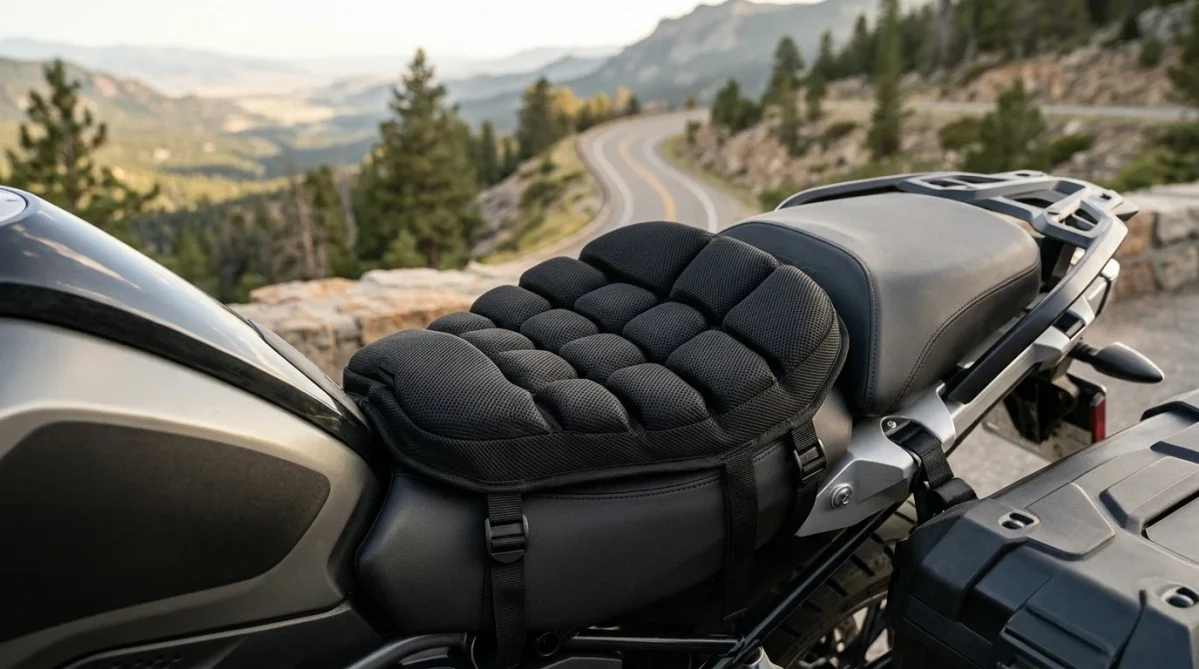
AIRHAWK motorcycle seat cushions use interconnected air cells designed to distribute pressure across the seating area.
Unlike a conventional foam cushion, an air-cell design allows the rider’s weight to shift across multiple chambers.
This approach is intended to reduce concentrated pressure points that can develop during longer periods in the saddle.
Why It’s Worth Considering
- Interconnected air-cell cushioning
- Adjustable air pressure
- Designed to distribute seating pressure
- Multiple sizes and shapes available
- Removable design
- Can be transferred between compatible motorcycles
- An alternative to replacing the entire motorcycle seat
One advantage of an AIRHAWK cushion is the ability to adjust its inflation level.
The manufacturer recommends using relatively little air rather than inflating the cushion until it feels firm.
For riders who find their original motorcycle seat uncomfortable, this can be a relatively straightforward upgrade to consider before investing in a replacement seat.
Things to Consider
AIRHAWK offers different cushion shapes and sizes, so choosing the correct version is important.
An improperly sized or overinflated cushion may feel unstable or raise the rider’s seating position more than desired.
A seat cushion also cannot correct every source of discomfort. Seat shape, riding posture, suspension settings, and the distance between the seat and footpegs can all influence comfort.
Riders should ensure the cushion is securely attached and does not interfere with their ability to control the motorcycle.
Our Take: An AIRHAWK seat cushion is worth considering for riders who want to address seat pressure without immediately replacing their motorcycle’s original seat.
2. Oxford HotGrips — Best for Cold-Weather Riding
Best For: Commuters, touring riders, and motorcyclists who frequently encounter cool temperatures.
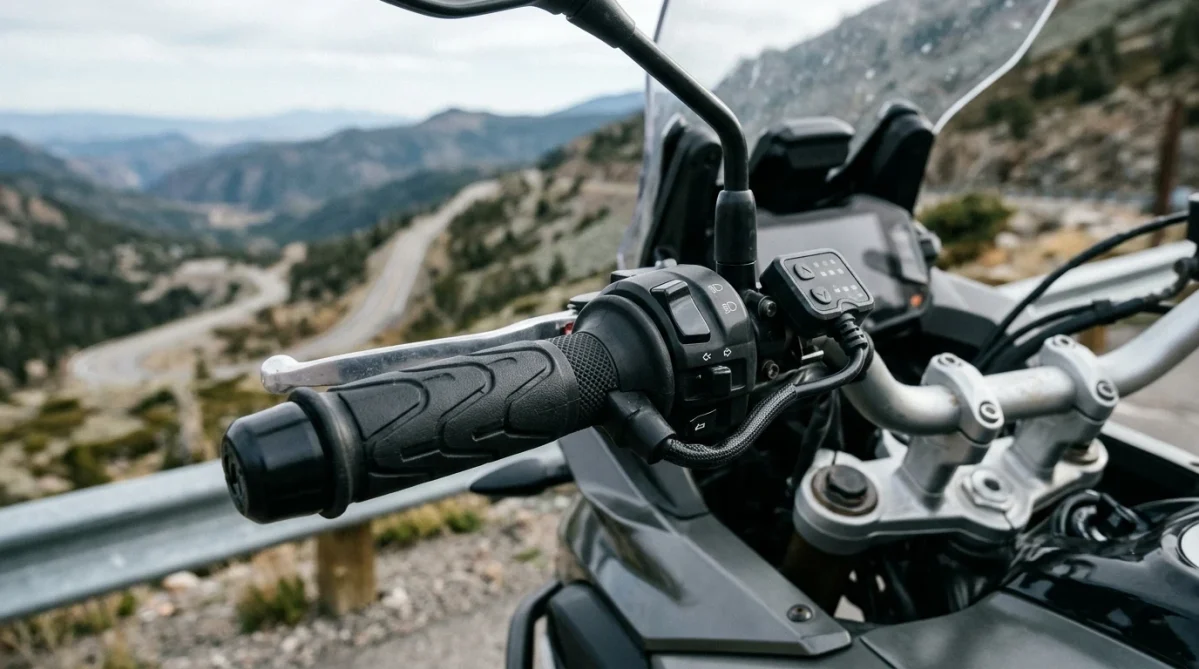
Cold hands can make riding uncomfortable and may reduce finger dexterity, particularly during longer rides.
Oxford HotGrips are replacement handlebar grips with integrated heating elements designed to provide adjustable warmth.
Different versions are available for various motorcycle styles, including touring, adventure, sport, and cruiser applications.
Why It’s Worth Considering
- Integrated grip heating elements
- Adjustable heat settings
- Motorcycle-specific grip styles
- Handlebar-mounted temperature controller on many versions
- Battery-saving technology on compatible models
- Durable grip materials
- Useful for commuting and touring in cooler weather
Heated grips can be especially valuable during early morning rides, mountain travel, and changing seasonal conditions.
They also allow riders to adjust warmth as temperatures change throughout the day.
Things to Consider
Oxford HotGrips are not universal across all motorcycles.
Handlebar diameter, grip length, throttle-tube compatibility, and available electrical capacity must be considered before purchasing.
Installation typically involves replacing the original grips and connecting the heating system to the motorcycle’s electrical system.
Heated grips also warm the palms more directly than the backs of the hands, so suitable riding gloves remain important.
Our Take: Oxford HotGrips are a practical comfort upgrade for riders who regularly encounter cold temperatures and want adjustable hand warmth.
3. CrampBuster Throttle Assist — Best for Reducing Hand Fatigue
Best For: Riders who want a simple accessory that may reduce the effort required to maintain a steady throttle position during longer rides.
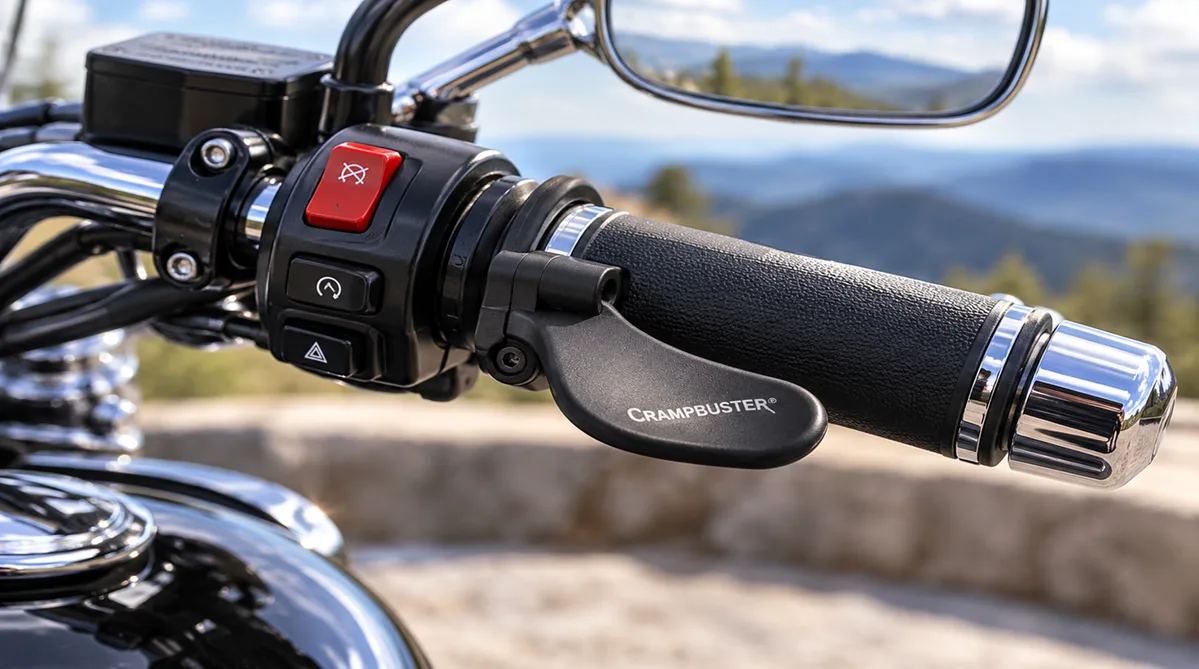
The CrampBuster is a small throttle-assist accessory designed to fit around a compatible motorcycle throttle grip.
Its paddle-shaped extension allows the rider to apply gentle pressure with the palm rather than relying entirely on a continuous gripping motion.
For some riders, this can help reduce hand fatigue during extended periods of steady-speed travel.
Why It’s Worth Considering
- Simple mechanical design
- No electrical connections
- No permanent motorcycle modifications
- Available in different sizes
- Quick installation on compatible grips
- Lightweight and compact
- Relatively inexpensive comfort upgrade
The CrampBuster can be particularly appealing to riders who experience discomfort from holding the throttle for long periods.
Its simplicity also makes it easy to remove if the rider prefers the original grip configuration.
Things to Consider
A CrampBuster is not cruise control.
The rider must continue controlling the throttle, and the accessory does not maintain a selected speed automatically.
Incorrect positioning can interfere with normal throttle operation or lead to unintended throttle input.
Riders should verify compatibility, follow the manufacturer’s instructions, and confirm that the throttle rotates and returns freely throughout the full steering range.
A throttle assist may not suit every rider or motorcycle.
Our Take: The CrampBuster is an affordable accessory worth considering for riders who want to reduce sustained gripping effort without installing an electronic cruise-control system.
Comfort matters most when you’re spending several hours exploring mountain roads. If you’re planning your next adventure, our Smoky Mountains Motorcycle Routes (Complete Riding Guide) highlights scenic routes and practical riding information to help you prepare for the journey.
What to Look for in Motorcycle Comfort Accessories
Before purchasing a comfort upgrade, consider the following factors:
- Source of discomfort: Identify whether the problem involves seating pressure, temperature, riding posture, or hand fatigue.
- Motorcycle compatibility: Verify that the accessory fits your motorcycle’s seat, handlebars, or controls.
- Adjustability: Look for products that allow you to tailor the fit or operation to your preferences.
- Installation requirements: Determine whether the accessory requires tools, electrical wiring, or professional assistance.
- Control access: Make sure the accessory does not interfere with steering, throttle operation, braking, or other essential controls.
- Riding conditions: Consider whether the upgrade is most useful for commuting, highway touring, or cold-weather riding.
- Long-term value: Choose accessories that address problems you regularly experience rather than occasional minor discomfort.
Remember that accessories are only one part of motorcycle comfort.
Riding posture, suspension settings, protective gear, hydration, and regular rest breaks also influence how comfortable you feel after several hours on the road.
Which Motorcycle Comfort Accessory Should You Choose?
An AIRHAWK seat cushion is worth considering if your primary concern is uncomfortable seating pressure during longer rides.
Oxford HotGrips are an appealing choice for riders who regularly travel in cooler weather and want adjustable hand warmth.
The CrampBuster throttle assist may be useful for riders who experience hand fatigue while maintaining a steady throttle position.
These accessories address different problems, so there is no single best choice for every rider.
The best motorcycle comfort accessory addresses a specific source of discomfort while preserving your ability to operate the motorcycle safely and confidently.
Best Motorcycle Emergency and Roadside Kits
Even a well-maintained motorcycle can experience an unexpected problem on the road.
A punctured tire, loose fastener, or discharged battery can quickly interrupt an otherwise enjoyable ride. While no emergency kit can solve every mechanical problem, carrying a few carefully selected tools and supplies can make certain roadside situations easier to manage.
For riders who regularly travel through rural areas or take longer motorcycle trips, basic roadside preparation is especially important.
Preparing for a mountain ride involves more than choosing the right route. Our Motorcycle Packing List For Smoky Mountains Rides will help you think through the equipment and essentials worth bringing before your next adventure.
Here are three practical motorcycle emergency and roadside accessories worth considering in 2026.
1. Stop & Go Tubeless Tire Repair Kit — Best for Temporary Puncture Repairs
Best For: Riders with compatible tubeless motorcycle tires who want a compact repair option for certain tread punctures.
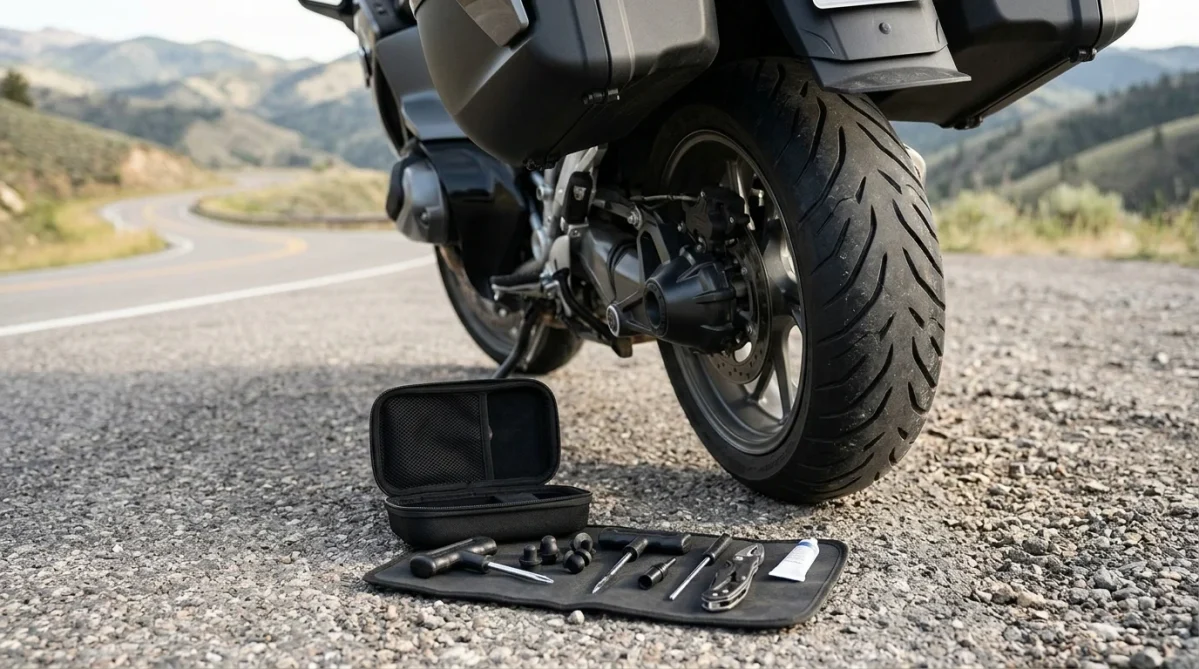
A punctured tire is one of the more frustrating problems a motorcyclist can encounter away from home.
Stop & Go offers motorcycle tire repair kits designed to insert rubber plugs into certain punctures in compatible tubeless tires.
These kits can provide a temporary roadside solution when the damage is suitable for plugging.
Why It’s Worth Considering
- Designed for compatible tubeless tires
- Compact roadside repair equipment
- Rubber plugging system
- Available kits with insertion tools and plugs
- Portable enough for motorcycle luggage
- Useful for certain punctures in the tire tread
- Can be paired with a portable air compressor
The primary advantage is convenience.
A compact repair kit takes up relatively little luggage space and may help a rider address a suitable puncture without immediately arranging transportation.
However, tire repair limitations are important to understand.
Things to Consider
Not every motorcycle tire can be safely repaired.
A roadside plug should be treated as an emergency measure, not a guarantee that the tire is safe for continued normal use.
Sidewall damage, large punctures, damaged tire cords, and tires that have been ridden while severely underinflated may require replacement.
Motorcycle tire manufacturers differ in their repair policies, and some do not approve repairs for particular tire types or applications.
Always follow the tire manufacturer’s guidance. If a temporary repair is permitted, arrange professional inspection as soon as possible and follow any restrictions on speed or distance.
Our Take: A Stop & Go repair kit is worth considering for riders with compatible tubeless tires, provided they understand that roadside repairs have important safety limitations.
2. Slime Power Sport Tire Inflator — Best for Portable Tire Inflation
Best For: Riders who want a compact air compressor for checking or restoring tire pressure during trips.
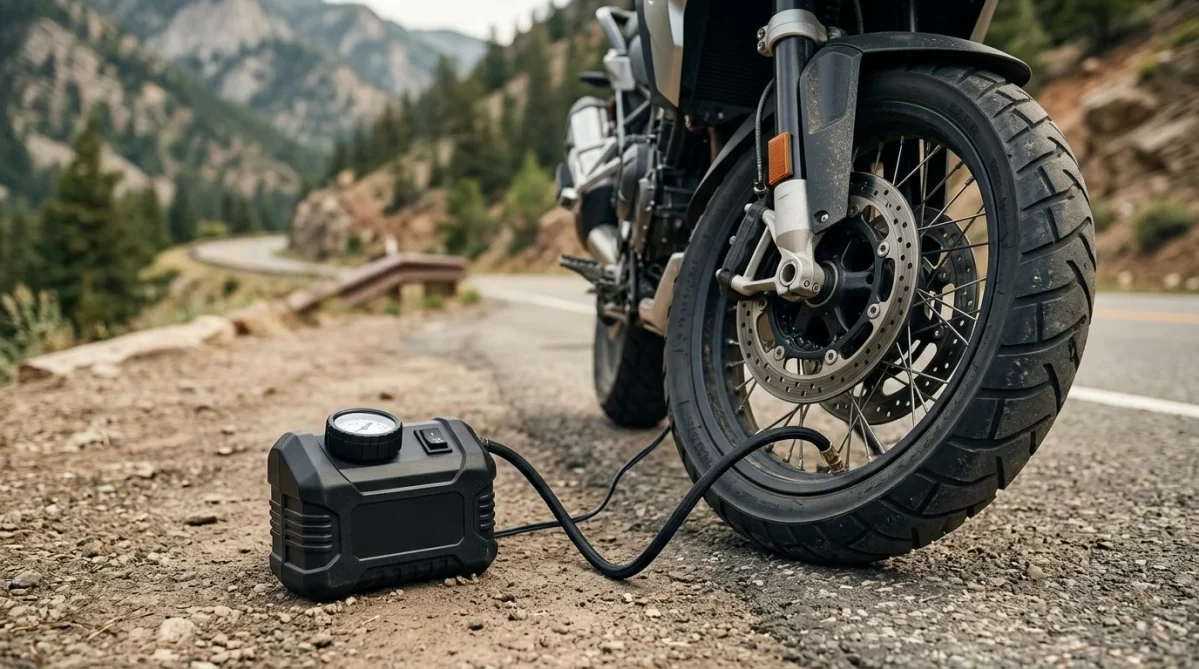
A portable tire inflator can be a valuable companion to a tire repair kit.
Slime’s Power Sport Tire Inflator is designed as a compact 12-volt compressor suitable for motorcycles and other powersports applications.
Its relatively small size makes it easier to carry than a full-size automotive compressor.
Why It’s Worth Considering
- Compact portable design
- 12-volt power operation
- Designed for powersports applications
- Includes inflation accessories
- Suitable for adding air to compatible tires
- Useful alongside a roadside puncture kit
- Can be stored in motorcycle luggage
A portable compressor is particularly useful when riding through areas where fuel stations or air pumps are difficult to find.
It can also help riders restore pressure after an appropriate temporary puncture repair.
Things to Consider
The inflator requires a compatible 12-volt power source.
Riders should verify that their motorcycle’s battery connection or accessory socket can safely supply the required current.
A compressor should not be connected to an electrical circuit that cannot support its power requirements.
Portable compressors also have operating limits and may require cooling periods during extended use.
Always use an accurate tire pressure gauge and follow the motorcycle manufacturer’s recommended cold tire pressures.
Our Take: The Slime Power Sport Tire Inflator is a practical accessory for riders who want a compact way to add tire pressure while traveling.
3. CruzTOOLS RoadTech Motorcycle Tool Kit — Best for Basic Roadside Adjustments
Best For: Touring riders who want a portable collection of tools for basic adjustments and minor mechanical issues.
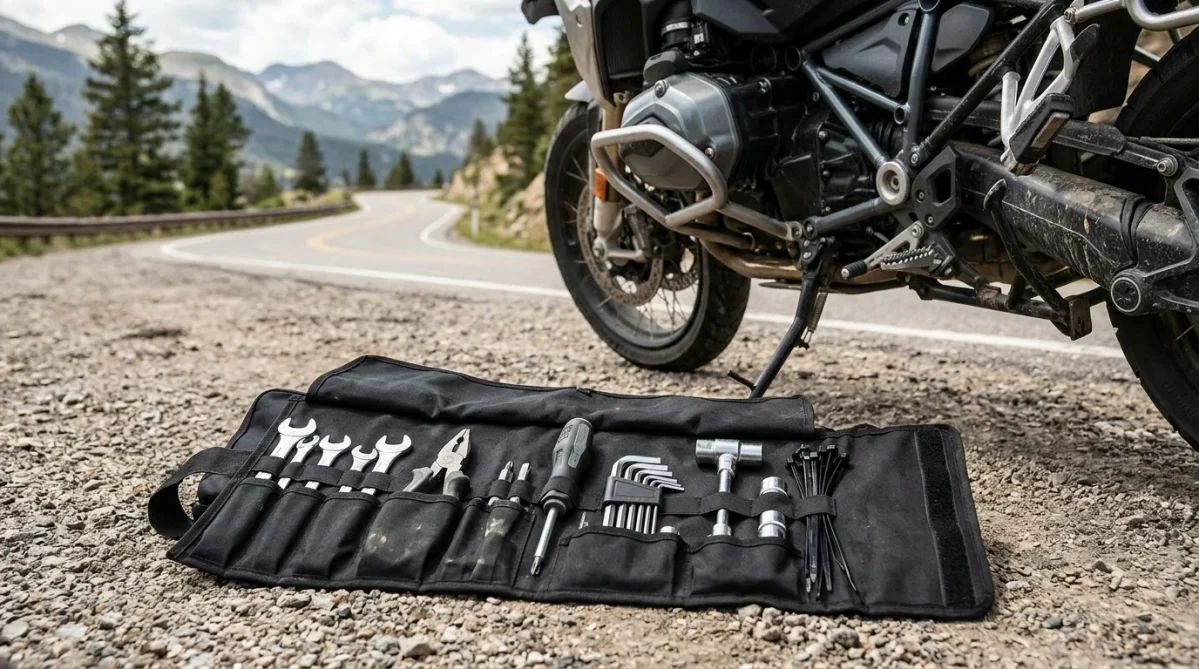
A motorcycle-specific tool kit can be useful when a loose fastener or minor mechanical problem interrupts a ride.
CruzTOOLS RoadTech tool kits are intended for different motorcycle applications, including certain Harley-Davidson, metric, and other motorcycle configurations.
These kits combine commonly needed hand tools in a portable storage pouch.
Why It’s Worth Considering
- Motorcycle-oriented tool selection
- Compact carrying pouch
- Combination wrenches and other hand tools, depending on the kit
- Hex keys and screwdrivers on applicable versions
- Useful for minor adjustments
- Designed for storage in motorcycle luggage
- Different kits available for different motorcycle types
One advantage of a dedicated motorcycle tool kit is having commonly used tools organized in one location.
For longer rides, this can be more convenient than assembling a loose collection of tools.
Things to Consider
No universal tool kit contains everything needed for every motorcycle.
Fastener sizes and service requirements differ between motorcycle manufacturers and models.
Before purchasing, compare the included tools with the fasteners and adjustments on your own motorcycle.
A compact kit is intended for basic roadside tasks, not major repairs.
Riders should avoid attempting repairs that exceed their experience or cannot be completed safely at the roadside.
Our Take: A CruzTOOLS RoadTech kit is a useful option for riders who want organized tools for minor adjustments and basic roadside maintenance.
Additional Motorcycle Emergency Supplies Worth Carrying
Beyond these three accessories, several inexpensive items can make a roadside kit more useful.
Consider carrying:
- Tire pressure gauge: For checking pressure accurately before and after inflation.
- Small flashlight or headlamp: Useful when inspecting a motorcycle in poor lighting.
- Compact first-aid kit: For basic treatment of minor injuries.
- Reflective safety equipment: To improve visibility when stopped near traffic.
- Portable battery jump starter: If compatible with your motorcycle’s battery and electrical system.
- Spare fuses: Correctly rated replacements for your motorcycle.
- Zip ties and electrical tape: Useful for securing certain loose components temporarily.
- Emergency contact information: Including roadside assistance details.
- Phone charging cable or power bank: To help maintain communication during an unexpected delay.
These supplies don’t need to occupy much space.
A small, organized pouch can often hold the most useful items while leaving room for regular riding gear.
What to Look for in a Motorcycle Roadside Kit
Before purchasing roadside equipment, consider the following factors:
- Motorcycle compatibility: Make sure the tools and equipment match your motorcycle’s components and electrical system.
- Tire construction: Verify whether your motorcycle uses tubeless tires or a tube-type setup.
- Storage space: Choose compact equipment that fits securely in your available luggage.
- Ease of use: Carry tools you understand and can operate safely.
- Power requirements: Confirm that compressors and jump starters are compatible with your motorcycle.
- Durability: Select equipment designed to tolerate transportation, vibration, and changing weather conditions.
- Emergency limitations: Understand which problems can be handled safely at the roadside and which require professional assistance.
It is also worth becoming familiar with your equipment before a trip.
Learning how to connect an inflator or locate your motorcycle’s battery terminals at home is considerably easier than figuring it out beside a busy highway.
Which Motorcycle Roadside Accessories Should You Choose?
A Stop & Go Tubeless Tire Repair Kit may be useful for riders with compatible tubeless tires who want an emergency option for certain punctures.
The Slime Power Sport Tire Inflator is worth considering for riders who want a portable way to add air to their tires.
A CruzTOOLS RoadTech kit is an appealing choice for basic adjustments and minor mechanical issues, provided the included tools match the motorcycle.
For many touring riders, a combination of these accessories offers more useful preparation than relying on a single all-purpose emergency kit.
However, carrying tools doesn’t replace regular motorcycle maintenance or professional roadside assistance.
If a tire, brake, steering component, or another safety-critical system is damaged, the safest decision may be to stop riding and arrange recovery.
The best motorcycle roadside kit prepares you for real problems, fits your motorcycle, and helps you decide when you need professional assistance.
How to Choose Accessories for Your Motorcycle
With so many motorcycle accessories available, it’s easy to spend money on upgrades that look appealing but provide little benefit for your riding style.
The best approach is to start with your motorcycle, identify the problems you want to solve, and choose accessories that offer practical improvements.
Before buying your next upgrade, consider the following factors.
1. Start With Your Riding Style
Different riding styles create different accessory needs.
A rider who primarily commutes to work may benefit from a secure phone mount, USB charger, and compact storage bag.
Someone who regularly travels several hundred miles a day places greater focus on wind protection, seating comfort, and storage space.
Adventure riders may prioritize waterproof storage and equipment suited to changing conditions.
Consider how you use your motorcycle most often rather than choosing accessories based on someone else’s riding preferences.
2. Identify Your Biggest Comfort or Convenience Problem
Before buying an accessory, ask yourself what you want it to improve.
For example:
- Difficulty following navigation: Consider a compatible motorcycle phone mount.
- Phone battery running low: Look into a properly installed USB charging system.
- Discomfort during longer rides: Evaluate seating, wind protection, and riding posture.
- Limited carrying capacity: Consider a tank bag, tail bag, or compatible luggage system.
- Cold hands: Heated grips may provide useful additional warmth.
- Difficulty communicating with riding partners: A compatible helmet communication system may help.
- Concern about roadside problems: Build a compact emergency kit suited to your motorcycle.
Focusing on a specific problem makes it easier to determine whether an accessory is worth purchasing.
It also helps prevent unnecessary upgrades.
3. Verify Motorcycle Compatibility
Compatibility should be one of your first considerations before purchasing any accessory.
Even products described as universal may have limitations.
Phone mounts must fit the available mounting locations. Windshields may require model-specific brackets. Luggage systems often depend on compatible racks or mounting hardware.
Electrical accessories introduce additional considerations, including battery voltage, available electrical capacity, fuse protection, and wiring requirements.
Before purchasing, check:
- Your motorcycle’s make, model, and year.
- The accessory manufacturer’s fitment information.
- Required mounting hardware or adapters.
- Installation instructions.
- Clearance around controls and moving components.
- Any electrical or weight limitations.
When compatibility is unclear, contact the manufacturer or a qualified motorcycle technician before ordering.
4. Consider Installation and Maintenance
Some motorcycle accessories are relatively simple to install.
A compatible tank bag or removable seat cushion may require only a few adjustments.
Other upgrades, such as heated grips, charging systems, and certain luggage racks, may involve additional tools or mechanical work.
Consider whether you’re comfortable completing the installation yourself.
Also think about ongoing maintenance.
Mounting bolts may require periodic inspection, electrical connections should remain protected, and luggage straps should be checked for wear.
An accessory that is difficult to install or maintain may not be the most practical choice for your needs.
5. Don’t Overlook Safety
Accessories should improve your motorcycle experience without interfering with safe operation.
A poorly positioned phone mount could obstruct instruments or controls. Improperly installed luggage could affect handling. Incorrect electrical wiring could create reliability or safety problems.
Before riding with a new accessory:
- Confirm that steering moves freely from lock to lock.
- Check that the throttle returns normally.
- Ensure brake and clutch controls remain unobstructed.
- Verify that luggage and mounting hardware are secure.
- Confirm that lights and instruments remain visible.
- Make sure cables cannot contact hot or moving components.
Follow the motorcycle and accessory manufacturers’ instructions, particularly when modifications affect safety-critical areas.
6. Balance Quality With Your Budget
You don’t necessarily need the most expensive accessory to get good results.
A straightforward product may provide everything an occasional rider needs.
However, accessories used frequently or exposed to demanding conditions may justify spending more for better materials, weather protection, mounting hardware, or manufacturer support.
Instead of comparing prices alone, consider the overall value.
Ask whether the additional features will improve your actual riding experience.
For example, paying more for a premium communication system may make sense if you regularly ride with a large group. It may offer little advantage if you almost always ride alone.
The goal is to spend where the benefits matter most.
7. Prioritize Accessories in the Right Order
If you’re building your motorcycle accessory setup gradually, there’s no need to purchase everything at once.
Start with accessories that solve your most frequent problems.
A practical approach might look like this:
First Priority: Everyday Essentials
Consider accessories that address immediate needs, such as secure storage, reliable navigation, or charging capability.
Second Priority: Comfort Improvements
Once your basic needs are covered, evaluate upgrades that make longer rides more enjoyable, including wind protection, heated grips, or seating accessories.
Third Priority: Touring and Travel Equipment
If you’re planning longer trips, additional luggage, communication equipment, and appropriate roadside supplies may become more valuable.
These priorities aren’t fixed. A rider who frequently travels through remote areas may reasonably place roadside preparation ahead of convenience accessories.
Choose the order that reflects your motorcycle, experience, and riding conditions.
8. Read Reviews With the Right Expectations
Customer reviews can be useful, but they should be evaluated carefully.
Look for feedback from riders who own motorcycles similar to yours or use the accessory under comparable conditions.
Pay attention to recurring comments about:
- Installation difficulties.
- Mounting security.
- Weather resistance.
- Long-term durability.
- Product compatibility.
- Customer service and warranty support.
A single positive or negative review rarely tells the complete story.
Compare multiple sources, check manufacturer specifications, and consider whether the reported experience applies to your situation.
A Simple Motorcycle Accessory Buying Checklist
Before making a purchase, ask yourself:
- Does this accessory solve a problem I regularly experience?
- Is it compatible with my motorcycle?
- Can it be installed without compromising safety?
- Does it provide the features I actually need?
- Is the construction appropriate for my riding conditions?
- Are replacement parts or manufacturer support available?
- Does the price make sense for how often I’ll use it?
If you can answer these questions confidently, you’re more likely to choose an accessory that provides lasting value.
The best motorcycle upgrades aren’t necessarily the newest or most expensive. They’re the ones that fit your motorcycle, address your actual needs, and make riding more comfortable, convenient, or enjoyable.
Quick Comparison: Motorcycle Accessories Worth Considering
With so many motorcycle accessories available, it helps to compare their practical benefits before deciding which upgrades deserve your attention.
The following table summarizes the accessories featured in this guide, along with their primary uses and the riders most likely to benefit from them.
Motorcycle Accessories Comparison Table
| Accessory | Recommended Product | Best For |
|---|---|---|
| Phone Mount | Quad Lock Motorcycle Handlebar Mount | Secure smartphone mounting and navigation |
| Phone Mount | RAM Mounts Quick-Grip | Flexible phone compatibility |
| Phone Mount | SP Connect Moto Mount Pro | Adjustable phone positioning |
| USB Charger | OptiMate USB O-108 | Everyday USB-A charging |
| USB Charger | OptiMate USB O-118 | Dedicated USB-C charging |
| Charging Accessory | Quad Lock Waterproof 12V to USB Smart Adaptor | Compatible Quad Lock wireless charging setups |
| Communication System | Cardo Packtalk Edge | Larger riding groups |
| Communication System | Sena 50S | Flexible mesh and Bluetooth communication |
| Communication System | Cardo Freecom 4X | Solo riders, passengers, and smaller groups |
| Motorcycle Luggage | GIVI ST611+ TANKLOCK Tank Bag | Everyday essentials and short rides |
| Motorcycle Luggage | Kriega OS-18 Adventure Pack | Waterproof touring and adventure storage |
| Motorcycle Luggage | SHAD SH39 Top Case | Lockable commuting and travel storage |
| Wind Protection | Puig Touring Windshield | Additional touring wind coverage |
| Wind Protection | National Cycle VStream | Motorcycle-specific airflow management |
| Wind Protection | MRA X-Creen Touring Spoiler | Adjustable wind deflection |
| Comfort Accessory | AIRHAWK Motorcycle Seat Cushion | Reducing seat pressure on longer rides |
| Comfort Accessory | Oxford HotGrips | Riding in cooler temperatures |
| Comfort Accessory | CrampBuster Throttle Assist | Reducing sustained throttle-hand effort |
| Roadside Equipment | Stop & Go Tubeless Tire Repair Kit | Emergency repairs for suitable tubeless tire punctures |
| Roadside Equipment | Slime Power Sport Tire Inflator | Portable tire inflation |
| Roadside Equipment | CruzTOOLS RoadTech Motorcycle Tool Kit | Basic roadside adjustments |
Product compatibility, installation requirements, and available features vary. Always verify the exact product version and motorcycle fitment before purchasing.
Best Accessories for Everyday Commuting
For riders who primarily use their motorcycles for commuting or shorter recreational trips, convenience often matters more than extensive touring equipment.
A secure phone mount, suitable charging system, and compact storage solution can help address common everyday needs.
Practical accessories to consider:
- Quad Lock Motorcycle Handlebar Mount
- OptiMate USB O-108
- GIVI ST611+ TANKLOCK Tank Bag
These upgrades can provide useful functionality without requiring a complete touring setup.
Best Accessories for Long-Distance Touring
Longer motorcycle trips introduce additional considerations, including comfort, luggage capacity, communication, and roadside preparation.
Accessories that seem unnecessary during a short ride may become considerably more valuable after several hours on the road.
Practical accessories to consider:
- AIRHAWK Motorcycle Seat Cushion
- National Cycle VStream Windshield
- Kriega OS-18 Adventure Pack
- Cardo Packtalk Edge
- Slime Power Sport Tire Inflator
The right combination depends on your motorcycle, travel distance, and personal comfort needs.
Best Accessories for Riding With a Passenger or Group
Communication can be particularly useful when traveling with a passenger or coordinating rides with several motorcycles.
A compatible helmet communication system allows riders to exchange information without relying on hand signals alone.
Practical accessories to consider:
- Cardo Packtalk Edge for compatible larger groups
- Sena 50S for riders using Sena’s mesh communication system
- Cardo Freecom 4X for smaller groups and passenger communication
Before purchasing, verify compatibility with the equipment your regular riding partners already use.
Best Accessories for Budget-Conscious Riders
Improving your motorcycle doesn’t always require purchasing premium accessories.
Smaller upgrades can provide useful benefits when they address a problem you regularly experience.
Practical accessories to consider:
- CrampBuster Throttle Assist
- A compact roadside tool kit suited to your motorcycle
- A basic charging solution compatible with your electrical system
Prices vary, so compare current costs and included accessories before purchasing.
Choosing the Right Combination
You don’t need every accessory featured in this guide.
For most riders, a better strategy is to begin with the upgrades that address their most frequent needs.
A commuter might prioritize navigation and storage, while a touring rider may benefit more from improved seating comfort and weather protection.
Riders who frequently travel through remote areas may place greater importance on roadside preparation.
The goal isn’t to equip your motorcycle with as many accessories as possible. It’s to choose a practical combination that makes your particular riding experience better.
Final Thoughts: Upgrade for the Way You Ride
The right motorcycle accessories can make everyday riding more convenient, improve comfort on longer trips, and help you prepare for unexpected situations on the road.
But the best upgrades aren’t necessarily the most expensive products or the ones with the longest list of features.
They’re the accessories that solve real problems and fit the way you ride.
A secure phone mount and reliable charging system may be valuable for riders who depend on smartphone navigation. Touring riders may appreciate improved wind protection, additional luggage, or a more comfortable seat.
For those who regularly travel with passengers or groups, a compatible communication system can make coordinating rides easier.
And regardless of your riding style, carrying appropriate roadside equipment is worth considering before your next long-distance trip.
Start With What Matters Most
If you’re unsure where to begin, think about your most recent motorcycle rides.
Was there something that made the experience less comfortable or convenient?
Perhaps your phone battery ran low, you struggled with limited storage, or you experienced uncomfortable wind pressure during highway travel.
Those experiences can help identify which accessories deserve your attention first.
Rather than purchasing several upgrades at once, consider making one practical improvement, evaluating how well it works, and deciding what you need next.
This approach can help you avoid unnecessary spending while building a motorcycle setup that suits your needs.
Make Compatibility and Safety a Priority
Before purchasing any accessory, confirm that it fits your motorcycle and can be installed correctly.
Pay particular attention to mounting security, electrical requirements, weight limits, and anything that could interfere with steering or other essential controls.
Manufacturer specifications, installation instructions, and feedback from riders with similar motorcycles can help you make a more informed decision.
Remember that no accessory can replace proper motorcycle maintenance, protective riding gear, or safe riding practices.
Enjoy the Ride
Motorcycle accessories should support your riding experience, not complicate it.
Whether you’re preparing for a weekend ride through the mountains, commuting across town, or planning a longer motorcycle adventure, choosing equipment that serves a clear purpose can make your time on the road more enjoyable.
At RiderWorx, our goal is to help you understand your options and make practical decisions based on your motorcycle, riding style, and budget.
Start with the upgrades that matter most, choose equipment that fits your motorcycle, and spend more time enjoying the ride.
Looking for more ways to prepare for your next ride? Explore our Riding Gear Guide for practical advice on choosing motorcycle equipment, improving comfort, and enjoying more of your time on the road.
Do you have a favorite ride or gear recommendation? Let us know.